
|
You entered: orbit
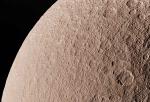 Rhea: Saturns Second Largest Moon
5.12.1999
Rhea is the second largest moon of Saturn, behind Titan, and the largest without an atmosphere. It is composed mostly of water ice, but has a small rocky core. Rhea's rotation and orbit are locked together (just like Earth's Moon) so that one side always faces Saturn.
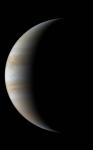 Farewell Jupiter
8.08.2001
Next stop: Saturn. The Cassini spacecraft, launched from Earth four years ago, has now swung past Jupiter and should arrive at Saturn in the year 2004. Pictured to the left is a parting shot from Cassini in January that would not have been possible from Earth: Jupiter showing a crescent phase.
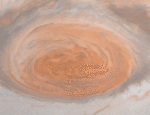 Galileo Zooms in on Jupiter's Red Spot
27.08.1996
What does the largest storm system ever recorded look like close-up? This storm system is Jupiter's Great Red Spot and it was captured recently in detail by the robot spacecraft Galileo now in orbit around Jupiter.
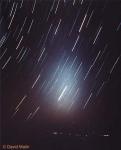 Zodiacal Light
26.08.1997
Sometimes the sky itself seems to glow. Usually, this means you are seeing a cloud reflecting sunlight or moonlight. If the glow appears as a faint band of light running across the whole sky, you are probably seeing the combined light from the billions of stars that compose our Milky Way Galaxy.
 Dark Sky, Bright Sun
14.02.1999
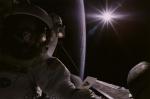
In low Earth orbit there is not enough atmosphere to diffuse and scatter sunlight, so shadows are black and the sky is dark - even when the Sun shines. The harsh lighting produced this dramatic...
 Lava Fountain on Jupiter's Io
20.12.1999
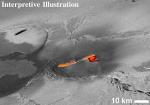
A lava fountain shooting over a kilometer high has been discovered on Jupiter's moon Io. The robot Galileo spacecraft orbiting Jupiter photographed the volcanic eruption during its close flyby of the moon late last month. The fountain is visible in the above mosaic of images from the flyby.
 Sentinels of a Northern Sky
10.01.2017
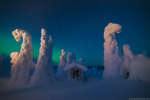
Who guards the north? The featured picture was taken last March in Finnish Lapland where weather can include sub-freezing temperatures and driving snow. Surreal landscapes sometimes result, where white alien-looking sentinels seem to patrol the landscape.
 The Small Cloud of Magellan (SMC)
30.04.2000
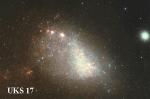
Almost unknown to casual observers in the northern hemisphere, the southern sky contains two diffuse wonders known as the Magellanic Clouds. The Magellanic Clouds are small irregular galaxies orbiting our own larger Milky Way spiral galaxy.
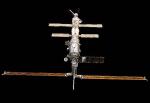 Approaching the International Space Station
30.04.2001
Earlier this month the crew of the US Space Shuttle Endeavor took in this view as they approached the developing International Space Station (ISS). The Endeavor and ISS crew installed Italy's Raffaello...
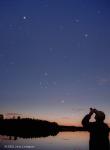 Dusk of the Planets
29.04.2002
A great grouping of planets is now visible to the west just after sunset. Over the next two weeks, Mercury, Venus, Earth, Mars, Jupiter, and Saturn -- all the planets of the inner Solar System -- can be seen in a single knowing glance. The image on the left captured them all in one frame.
|
January February March April May June July August September |
|||||||||||||||||||||||||||||||||||||||||||||||||