
|
You entered: orbit
 Asteroids in the Distance
6.03.2011
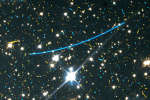
Rocks from space hit Earth every day. The larger the rock, though, the less often Earth is struck. Many kilograms of space dust pitter to Earth daily. Larger bits appear initially as a bright meteor. Baseball-sized rocks and ice-balls streak through our atmosphere daily, most evaporating quickly to nothing.
 Lightning on Jupiter
12.05.1997
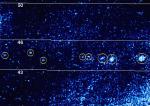
Does lightning occur only on Earth? Spacecraft in our Solar System have detected radio signals consistent with lightning on other planets, including Venus, Jupiter, Saturn, Uranus, and Neptune. In the above photograph, optical flashes from Jupiter were photographed recently by the Galileo orbiter. Each of the circled dots indicates lightning.
 The Doubly Warped World of Binary Black Holes
16.04.2021
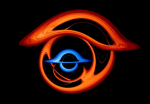
Light rays from accretion disks around a pair of orbiting supermassive black holes make their way through the warped space-time produced by extreme gravity in this stunning computer visualization. The simulated accretion disks have...
 Jupiter's Moon Amalthea
3.11.1995
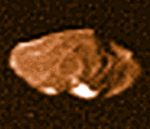
Amalthea is Jupiter's fifth largest moon, much smaller than the four Galilean satellites Io, Europa, Ganymede, and Callisto. The orbit of Amalthea is inside of these moons, and with its long axis always pointing toward Jupiter. It's dark surface color is probably due to sulfur being expelled from Io.
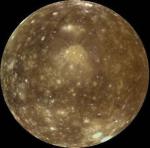 Callisto in True Color
11.05.1998
Callisto's surface has many stories to tell. The most distant of Jupiter's Galilean Moons, Callisto shows the highest density of impact craters in the Solar System, but harbors no volcanoes or even any large mountains. Callisto's surface is laced with cracks and craters from
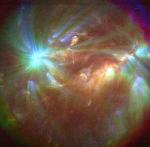 Sun Dance
11.08.1998
Hot gas dances across the surface of the Sun in this picture from the orbiting TRACE satellite. The temperature of the gas is color coded so that blue represents hundreds of thousands of Kelvin, while red represents extreme temperatures in the millions of Kelvin.
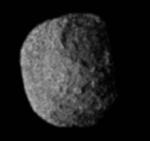 Neptune's Moon Proteus
4.11.1995
Proteus is the second largest moon of Neptune behind the mysterious Triton. Proteus was discovered only in 1982 by the Voyager 2 spacecraft. This is unusual since Neptune has a smaller moon - Nereid - which was discovered 33 years earlier from Earth.
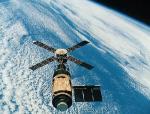 Skylab Over Earth
10.05.1998
Skylab was an orbiting laboratory launched by a Saturn V rocket in May 1973. Skylab was visited three times by NASA astronauts who sometimes stayed as long as two and a half months. Many scientific tests were performed on Skylab, including astronomical observations in ultraviolet and X-ray light.
 The Mountains of Mars
19.07.1995
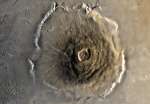
Volcanic activity on Mars has produced towering mountains. The largest one, Olympus Mons, is pictured here in this Viking Orbiter image. Olympus Mons is a shield volcano nearly 15 miles high and over 300 miles wide at its base.
 Skylab Over Earth
29.04.2006
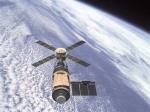
Skylab was an orbiting laboratory launched by a in May 1973. Skylab, pictured above, was visited three times by NASA astronauts who sometimes stayed as long as two and a half months. Many scientific tests were performed on Skylab, including astronomical observations in ultraviolet and X-ray light.
|
January February March April May June July August September |
|||||||||||||||||||||||||||||||||||||||||||||||||