
|
You entered: orbit
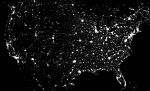 The United States At Night
8.07.2000
This is what the United States of America looks like at night! Can you find your favorite US city in this image? Surprisingly, city lights make this task quite possible. The above picture is actually a composite of over 200 images made by satellites orbiting planet Earth.
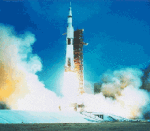 Saturn V: NASA's Largest Rocket
29.08.1995
Pictured, a NASA Saturn V rocket blasts off on July 16th, 1969 carrying the crew of Apollo 11 to the Moon. The Saturn V rocket was the largest rocket ever used by NASA, and the only one able to lift the large masses needed to land astronauts on the moon and returning them safely.
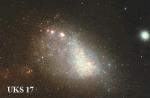 The Small Cloud of Magellan (SMC)
25.01.1998
Almost unknown to casual observers in the northern hemisphere, the southern sky contains two diffuse wonders known as the Magellanic Clouds. The Magellanic Clouds are small irregular galaxies orbiting our own larger Milky Way spiral galaxy.
 Europe at Night
16.05.1999
This is what Europe looks like at night! Can you find your favorite European city? Although not all of Europe is shown, city lights might make this task possible. The above picture is actually a composite of over 200 images made by satellites orbiting the Earth.
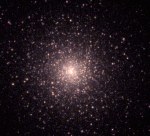 M15: A Great Globular Cluster
26.07.1995
A globular cluster is a system of about one million stars that together orbit a galaxy. One of the brightest globular clusters in our Milky Way galaxy is the pictured M15, the fifteenth object on Messier's list of diffuse objects on our sky.
 Asia at Night
28.07.1999
This is what Asia looks like at night! Can you find your favorite Asian city? Although not all of Asia is shown, city lights might make this task possible. The above picture is actually a composite of over 200 images made by satellites orbiting the Earth.
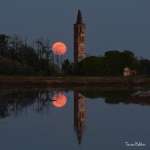 Full Flower Moonrise
9.05.2020
Rising as the Sun set, the Moon was bright and full in planet Earth skies on May 7 and known to some as a Flower Moon. Near the horizon it does seem to take on rose pink hues of reddened sunlight in this reflective twilight scene.
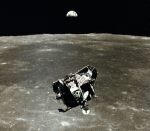 The Eagle Soars
21.07.1996
On July 21, 1969 Apollo 11 astronauts Neil A. Armstrong and Edwin E. "Buzz" Aldrin Jr. lifted off the lunar surface in the ascent stage of their lunar module dubbed "The Eagle" -- after becoming the first to walk on the moon.
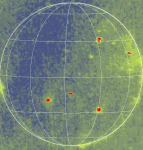 Io's Active Volcanoes
27.10.1996
Why is Io green at night? In this just-released nighttime picture of Jupiter's moon Io, the red spots clearly show Io's current volcanically active regions. But what is causing the global green sheen? This telling picture was taken by the automated Galileo spacecraft currently orbiting Jupiter while Io was in Jupiter's shadow.
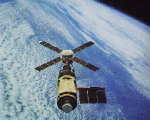 Skylab Over Earth
30.08.1995
Skylab was an orbiting laboratory launched by a Saturn V rocket in May 1973. Skylab was visited three times by NASA astronauts who sometimes stayed as long as two and a half months. Many scientific tests were preformed on Skylab, including astronomical observations in ultraviolet and X-ray light.
|
January February March April May June July August September |
|||||||||||||||||||||||||||||||||||||||||||||||||