
|
You entered: orbit
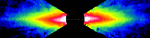 The Dusty Disk of Beta Pic
19.01.1996
This dusty disk, viewed edge on surrounding Beta Pictoris, a star only 50 lightyears distant, may signal the presence of an infant solar system. Beta Pictoris is a young Sun-like star just completing its formative stages.
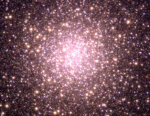 Globular Cluster M3
6.12.1996
This huge ball of stars predates our Sun. Long before mankind evolved, before dinosaurs roamed, and even before our Earth existed, ancient globs of stars condensed and orbited a young Milky Way Galaxy.
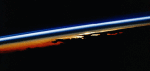 The Sun Also Rises
15.01.2000
Sunrise seen from low Earth orbit can be very dramatic indeed (and the authors don't apologize to Hemingway for using his title!). In this breathtaking view from the space shuttle Endeavor, the Sun is just visible peaking over towering anvil-shaped storm clouds.
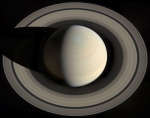 Saturn from Above
21.10.2013
This image of Saturn could not have been taken from Earth. No Earth based picture could possibly view the night side of Saturn and the corresponding shadow cast across Saturn's rings. Since Earth is much closer to the Sun than Saturn, only the day side of the ringed planet is visible from the Earth.
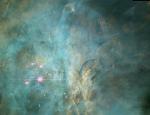 In the Center of the Trapezium
2.03.2003
Start with the constellation of Orion. Near Orion's belt is a fuzzy area known as the Great Nebula of Orion or M42. In this nebula is a bright star cluster known as the Trapezium, shown above. New stellar systems are forming there in gigantic globs of gas and dust known as Proplyds.
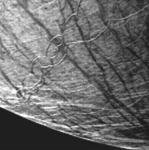 Ice Cusps on Europa
9.06.1998
Europa's icy crust has many unusual features. Pictured above is part of Europa's southern hemisphere photographed by the Galileo spacecraft currently orbiting Jupiter. Europa is one of the largest moons of Jupiter, and is thought to have oceans of water underneath its ice-covered surface.
 Polar Polygons on Mars
14.07.2004
What's the best way to the city center? What looks like a street map of some city on Earth is actually a series of naturally-formed fragmented polar polygons on Mars. The existence...
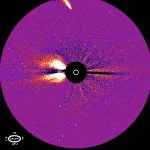 Comet Hyakutake and a Solar Flare
17.05.1996
A rare coincidence was recently captured by the orbiting SOHO spacecraft. During the closest approach to the Sun of Comet Hyakutake on May 1, SOHO photographed the comet. By accident -- during the time this photograph was being taken -- a solar flare was being ejected from the Sun.
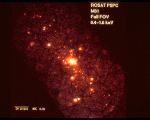 The X-ray Sources of M31
31.12.1995
Just like our own Milky Way Galaxy, the nearest major galaxy M31 has many star systems spewing high energy radiation. High energy X-radiation is visible to certain satellites in Earth orbit such as ROSAT - which took the above picture.
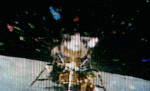 Blasting Off From the Moon
9.06.1996
How did the astronauts get back from the Moon? The Lunar Module that landed two astronauts on the Moon actually came apart. The top part containing the astronauts carried additional rocket fuel which allowed it to blast away, leaving the bottom part on the Moon forever.
|
January February March April May June July August September |
|||||||||||||||||||||||||||||||||||||||||||||||||