
|
You entered: orbit
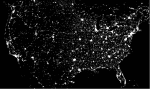 The United States at Night
17.06.1996
This is what the United States of America looks like at night! Can you find your favorite US city on this image? Surprisingly, city lights make this task quite possible. The above picture is actually a composite of over 200 images made by satellites orbiting the Earth.
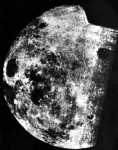 The Far Side
14.09.1995
This historic picture was humanity's first glimpse of the far side of the Moon. It was taken by the Soviet spacecraft Luna 3 in October of 1959. Luna 3 followed closely...
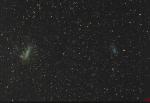 A Magellanic Mural
3.02.1998
Two galaxies stand out to casual observers in Earth's Southern Hemisphere: the Large Magellanic Cloud (LMC) and the Small Magellanic Cloud (SMC). These irregular galaxies are two of the closest galaxies to our Milky Way Galaxy.
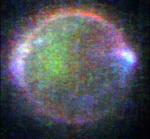 Io Aurora
16.10.1998
Alluring aurora surrounding Io (eye-oh) appear as a ghostly glow while the volcanic moon orbits within Jupiter's dark shadow. Gas giant Jupiter is off to the right of this image, recorded in May by the robot Galileo spacecraft's solid state imaging camera from a distance of about 1.3 million kilometers.
 A Jupiter Venus Conjunction
8.03.1999
Venus and Jupiter appeared unusually close together in the sky last month. The conjunction was easily visible to the unaided eye because Venus appears brighter than any background star. The two planets were not significantly closer in space - Venus just passed nearly in front of Jupiter as seen from the Earth.
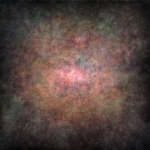 Median Mashup: Hubble s Top 100
13.09.2014
Now, as you sip your cosmic latte you can view 100 Hubble Space Telescope images at the same time. The popular scenes of the cosmos as captured from low Earth orbit are all combined into this single digital presentation. To make it, Hubble's top 100 images were downloaded and resized to identical pixel dimensions.
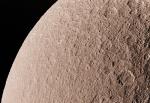 Rhea: Saturn's Second Largest Moon
8.06.2003
Rhea is the second largest moon of Saturn, behind Titan, and the largest without an atmosphere. It is composed mostly of water ice, but has a small rocky core. Rhea's rotation and orbit are locked together (just like Earth's Moon) so that one side always faces Saturn.
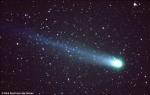 Hyakutake: Stars Through A Comet Tail
17.07.1998
Comets are cosmic icebergs. They follow very elongated orbits which carry them from the frozen, remote outer reaches of the Solar System to close encounters with the Sun. Heated by sunlight, they slough off layers of material as gas and dust, forming their characteristic awe-inspiring comas (heads) and tails.
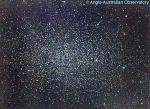 Nearby Dwarf Galaxy Leo I
3.10.1999
Leo I is a dwarf spheroidal galaxy in the Local Group of galaxies dominated by our Milky Way Galaxy and M31. Leo I is thought to be the most distant of the eleven known small satellite galaxies orbiting our Milky Way Galaxy.
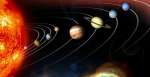 To Scale: The Solar System
25.12.2015
Want to build a scale model Solar System? A blue marble 1.4 centimeters (about half an inch) across would be a good choice for a scale model Earth. Since the Sun is 109 times the diameter of Earth, a 1.5 meter diameter balloon could represent the Sun.
|
January February March April May June July August September |
|||||||||||||||||||||||||||||||||||||||||||||||||