
|
You entered: orbit
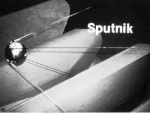 Sputnik: The Traveling Companion
11.02.1996
Sputnik means "traveling companion". In stark contrast to this innocent sounding name, the launch of the Earth's first "artificial moon", Sputnik 1, by the Soviets on October 4, 1957 shocked the free world, setting in motion events which resulted in the creation of NASA and the race to the Moon.
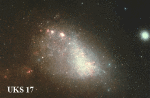 The Small Cloud of Magellan
19.07.1997
The southern sky contains wonders almost unknown in the north. These wonders include the Large and Small Magellanic Clouds: small irregular galaxies orbiting our own larger Milky Way spiral galaxy. The Small Magellanic Cloud (SMC), pictured here, is about 250,000 light years away.
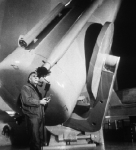 Edwin Hubble Discovers the Universe
21.06.1998
No person in history has had greater impact in determining the extent of our universe than Edwin Hubble. From proving that other galaxies existed to proving that galaxies move apart from one another, Hubble's work defined our place in the cosmos.
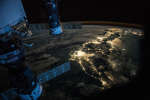 Cities at Night
5.03.2016
Looking toward the south from an altitude of 400 kilometers, this stunning snapshot from orbit finds bright lights of Tokyo and cities across central and southern Japan, planet Earth shining upward through broken clouds. The spacefaring perspective was captured last July by astronaut Scott Kelly during his stay on board the International Space Station.
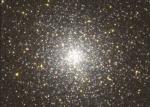 Globular Cluster 47 Tucanae
22.04.2001
Stars come in bunches. Of the over 200 globular star clusters that orbit the center of our Milky Way Galaxy, 47 Tucanae is the second brightest globular cluster (behind Omega Centauri). Known to some affectionately as 47 Tuc or NGC 104, it is only visible from the Southern Hemisphere.
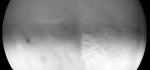 A Global Dust Storm on Mars
1.10.2001
A dust storm on Mars can involve nearly the entire planet. As spring descended on the southern hemisphere of the red planet this June and July, a global dust storm raged. Pictured above is the storm on July 8 as it spread up from the south, oriented on the lower right.
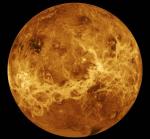 Venus Unveiled
30.03.2002
The surface of Venus is perpetually covered by a veil of thick clouds and remains hidden from even the powerful telescopic eyes of earth-bound astronomers. But in the early 1990s, using imaging radar...
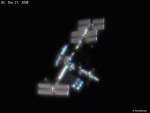 ISS: Reflections of Earth
16.01.2009
Remarkable details are visible in this view of the orbiting International Space Station (ISS), recorded with a small telescope on planet Earth through a clear twilight sky. Seen on December 27th at about...
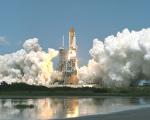 Space Shuttle Lifts Off for Space Station
23.04.2001
Last Thursday, Space Shuttle Endeavor lifted off on course for the latest round of building the International Space Station (ISS) in orbit around Earth. One of the highlights of the 11-day mission promises to be the installation of Canadarm2, a robotic arm that will assist in the future construction and utilization of the ISS.
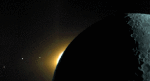 The Ecliptic Plane
27.09.1997
The Plane of the Ecliptic is illustrated in this Clementine star tracker camera image which reveals (from right to left) the Moon lit by Earthshine, the Sun's corona rising over the Moon's dark limb, and the planets Saturn, Mars, and Mercury.
|
January February March April May June July August September |
|||||||||||||||||||||||||||||||||||||||||||||||||