
|
You entered: orbit
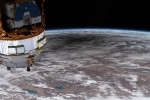 Eclipse under the ISS
27.06.2020
The dark shadow of the New Moon reached out and touched planet Earth on June 21. A high definition camera outside the International Space Station captured its passing in this snapshot from low Earth orbit near the border of Kazakhstan and China.
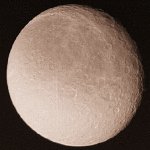 Rhea: Saturn's Second Largest Moon
14.10.1995
Rhea is the second largest moon of Saturn, behind Titan, and the largest without an atmosphere. It is composed mostly of water ice, but has a small rocky core. Rhea's rotation and orbit are locked together (just like Earth's Moon) so that one side always faces Saturn.
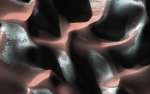 Martian Chiaroscuro
22.03.2014
Deep shadows create dramatic contrasts between light and dark in this high-resolution close-up of the martian surface. Recorded on January 24 by the HiRISE camera onboard the Mars Reconnaissance Orbiter, the scene spans about 1.5 kilometers across a sand dune field in a southern highlands crater.
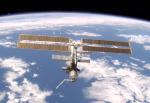 International Space Station Over Earth
2.01.2002
High above a cloudy Earth, the International Space Station (ISS) orbits silently. The Space Shuttle Endeavor Crew took the above picture as they departed the space station in mid-December. Endeavor brought up three...
 The Iron Moon
1.06.1996
In March and April of 1994 the unmanned Clementine spacecraft demonstrated the technique of prospecting on the Moon from lunar orbit. To accomplish this, Clementine turned an array of cameras sensitive to ultraviolet-visible and near-infrared light toward the lunar surface, producing the first broad-spectrum global imaging of the moon.
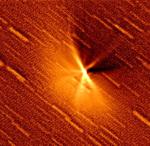 More Jets from Comet Hale-Bopp
13.02.1997
Comets become fountains of gas and dust as they get near the Sun. Solar heat vaporizes the outer layers of these spectacular orbiting icebergs, exposing caverns of pressurized gas that erupt into jets. The above digitally enhanced image of Comet Hale-Bopp was taken on January 29th and highlights several of these dust jets.
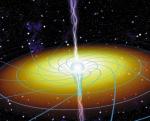 Evidence for Frame Dragging Black Holes
7.11.1997
Gravity can do more than floor you. According to recent measurements of a star system thought to contain a black hole, it can spin you too. This effect, called frame-dragging, is most prominent near massive, fast spinning objects. Now, a team led by W.
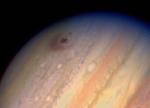 Impact on Jupiter
28.07.1998
In 1993, a strange string of comet pieces was discovered near the planet Jupiter. So unusual a sight, Comet Shoemaker-Levy 9 (SL9) quickly became the object of much scientific curiosity. Studies showed that the Sun would soon perturb the orbit of SL9 so that it would actually
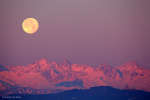 Alpine Superga Moonset
8.12.2017
December's Full Moon phase occurred near perigee, the closest point in its orbit around our fair planet. Big and bright, the fully illuminated lunar disk sets over rugged mountains in this early morningscape from Turin, Italy.
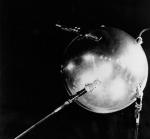 Sputnik: Traveling Companion
3.10.1998
Sputnik means "traveling companion". Despite the innocuous sounding name, the launch of the Earth's first "artificial moon", Sputnik 1, by the Soviets on October 4, 1957 shocked the free world, setting in motion events which resulted in the creation of NASA and the race to the Moon.
|
January February March April May June July August September |
|||||||||||||||||||||||||||||||||||||||||||||||||