
|
You entered: orbit
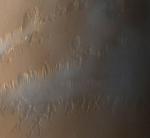 Mars: A Mist In Mariner Valley
17.10.1997
An icy mist and late afternoon clouds cover much of this section of Valles Marineris on Mars. The Valles Marineris or Mariner Valley is a huge canyon system about 2,000 miles long and up to 5 miles deep.
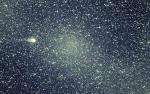 The Gegenschein
25.06.1999
If you look carefully enough, you can even see the glow of the Sun in the opposite direction. At night this glow is known as the gegenschein (German for "counter glow"), and can be seen as a faint glow in an extremely dark sky, as pictured above.
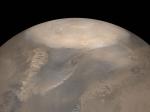 Spring Dust Storms at the North Pole of Mars
24.12.2002
Spring reached the north pole of Mars in May, and brought with it the usual dust storms. As the north polar cap begins to thaw, a temperature difference occurs between the cold frost region and recently thawed surface, resulting in swirling winds between the adjacent regions.
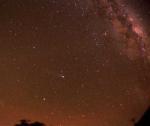 Comet Hyakutake and the Milky Way
17.08.1998
Two years ago, the Great Comet of 1996, Comet Hyakutake, inched across our northern sky during its long orbit around the Sun. Visible above as the bright spot with the faint tail near...
 Liftoff of Space Shuttle Columbia
6.08.1995
On April 12, 1981, space flight entered a new era with the first launch of Space Shuttle Columbia, shown above. NASA's Space Shuttles land like a normal plane, carry a heavy cargo, carry a large crew, make use of cheap solid fuel, and are reusable.
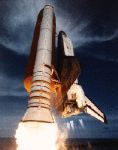 Challenger Launches Spacelab 2
9.08.1995
Space Shuttle Challenger jumps off the launch pad in 1985 to begin a successful mission. The main purpose of this mission was to test a new space based laboratory named Spacelab 2. Spacelab...
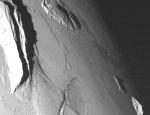 Io at Sunset
20.01.2003
How tall are mountains on Jupiter's moon Io? One way to find out is to view them at sunset. Tall structures facing the Sun are then better-lit and cast long shadows. The above...
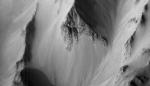 Mars: A Sheer Close Up
13.11.1997
As the Mars Global Surveyor spacecraft maneuvers toward its final mapping orbit, its cameras have been producing some sharp views of Mars. At a resolution of better than 30 feet per pixel, this image...
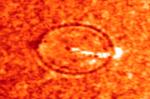 Solar Flares Cause Sun Quakes
1.06.1998
An 11th magnitude quake has been recorded on the Sun, immediately following a moderate solar flare. The quake was the first ever recorded on the Sun, but only because astronomers have only recently figured out when and how to find them using the orbiting SOHO spacecraft.
 Zodiacal Light
13.06.1999
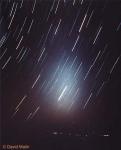
Sometimes the sky itself seems to glow. Usually, this means you are seeing a cloud reflecting sunlight or moonlight. If the glow appears as a faint band of light running across the whole sky, you are probably seeing the combined light from the billions of stars that compose our Milky Way Galaxy.
|
January February March April May June July August September |
|||||||||||||||||||||||||||||||||||||||||||||||||