
|
You entered: orbit
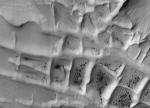 Mars: Ridges Near the South Pole
20.03.1998
No, it's not breakfast ... but looking down from an orbiting spacecraft, the odd intersecting ridges covering this area of Mars do present a waffle-like appearance. The cause of the ridge pattern is unknown but it suggests that more complex layered deposits lie below.
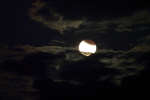 A Partial Lunar Eclipse
28.06.2010
What's happened to the Moon? This past weekend, once again, part of the Moon moved through the Earth's shadow. This happens about once or twice a year, on the average, but not each month since the Moon's orbit around the Earth is slightly tilted.
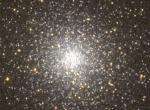 Globular Cluster 47 Tucanae
7.11.1998
Stars come in bunches. Of the over 200 globular star clusters that orbit the center of our Milky Way Galaxy, 47 Tucanae is the second brightest globular cluster (behind Omega Centauri). Known to some affectionately as 47 Tuc or NGC 104, it is only visible from the Southern
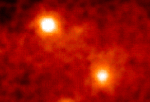 Gamma Ray Crab, Geminga
24.06.1995
What if you could "see" in gamma-rays? If you could, these two spinning neutron stars or pulsars would be among the brightest objects in the sky. This computer processed image shows the Crab Nebula pulsar (below and right of center) and the Geminga pulsar (above and left of center) in the "light" of gamma-rays.
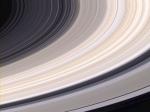 Saturns Rings in Natural Color
23.07.2004
What colors are Saturn's rings? Recent images from the Cassini spacecraft now orbiting Saturn confirm that different rings have slightly different colors. The above image shows their sometimes-subtle differences in brightness and color. The rings reflect sunlight and so, even if they were perfectly reflecting, would appear the color of the Sun.
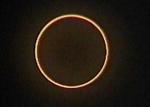 An Annular Eclipse of the Sun
24.08.1998
An annular eclipse of the Sun was visible in parts of the Eastern Hemisphere on Saturday. The above picture was taken at that time by a video camera in Mersing on the East Coast of Malaysia and emailed to APOD yesterday from an internet cafe in Kuala Lumpur.
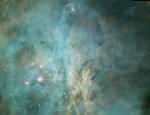 In the Center of the Trapezium
10.07.2005
Start with the constellation of Orion. Near Orion's belt is a fuzzy area known as the Great Nebula of Orion or M42. In this nebula is a bright star cluster known as the Trapezium, shown above. New stellar systems are forming there in gigantic globs of gas and dust known as Proplyds.
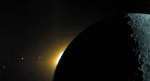 The Ecliptic Plane
29.05.1999
The Plane of the Ecliptic is illustrated in this Clementine star tracker camera image which reveals (from right to left) the Moon lit by Earthshine, the Sun's corona rising over the Moon's dark limb, and the planets Saturn, Mars, and Mercury.
 Venus on the Horizon
19.06.1999
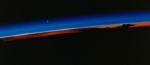
Venus can appear as a brilliant evening star. Besides the sun and moon, Venus is the brightest object visible in Earth's sky. Because it is closer to the sun than Earth, Venus never...
 Earth and Moon from Saturn
22.07.2013
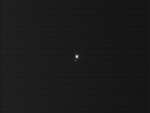
You are here. Everyone you've ever known is here. Every human who has ever lived -- is here. Pictured above is the Earth-Moon system as captured by the Cassini mission orbiting Saturn in the outer Solar System.
|
January February March April May June July August September |
|||||||||||||||||||||||||||||||||||||||||||||||||