
|
You entered: orbit
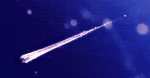 Catching Falling Stardust
24.01.1996
This carrot shaped track is actually little more than 5 hundredths of an inch long. It is the trail of a meteroid through a gel exposed to space in low earth orbit by the shuttle launched EURECA (European Recoverable Carrier) spacecraft.
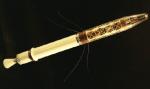 Explorer I
12.02.1998
Inaugurating the era of space exploration for the US, the First Explorer was launched into Earth orbit forty years ago (February 1, 1958) by the Army Ballistic Missle Agency. The Explorer I satellite weighed...
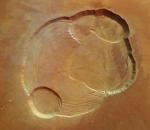 At the Summit of Olympus Mons
26.05.2004
From martian orbit, the Mars Express cameras looked down on the largest volcano in the solar system. The result was this stunningly detailed overhead view of the caldera or summit crater region of Olympus Mons.
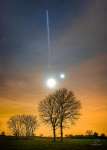 Conjunction of Four
3.02.2017
On January 31, a waxing crescent Moon, brilliant Venus, and fainter Mars gathered in the fading twilight, hanging above the western horizon just after sunset on planet Earth. In this combined evening skyscape, the lovely celestial triangle is seen through clouds and haze.
 Earth at Night
26.11.2000
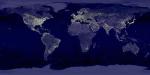
This is what the Earth looks like at night. Can you find your favorite country or city? Surprisingly, city lights make this task quite possible. Human-made lights highlight particularly developed or populated areas of the Earth's surface, including the seaboards of Europe, the eastern United States, and Japan.
 The Small Cloud of Magellan
19.09.1995
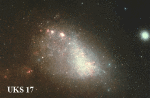
Almost unknown to casual observers in the northern hemisphere, the southern sky contains two diffuse wonders known as the Magellanic Clouds. The Magellanic Clouds are small irregular galaxies orbiting our own larger Milky Way spiral galaxy.
 Edwin Hubble Discovers the Universe
16.02.1996
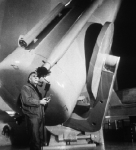
No person in history has had greater impact in determining the extent of our universe than Edwin Hubble. From proving that other galaxies existed to proving that galaxies move apart from one another, Hubble's work defined our place in the cosmos.
 Ocean Planet Pole To Pole
7.10.1998
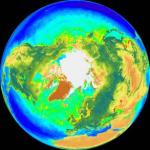
The Sea-viewing Wide Field-of-view Sensor (SeaWiFS) instrument onboard the orbiting SeaStar spacecraft can map subtle differences in Earth's ocean color. These North (left) and South Pole projections are based on SeaWiFS measurements made between September 1997 and July 1998.
 APOD Is Ten Years Old Today
16.06.2005
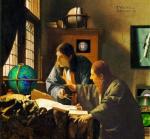
Welcome to the eleventh year of Astronomy Picture of the Day! In a decade of editing the APOD web pages, the industrious Robert Nemiroff (left) and persistent Jerry Bonnell (right) have enjoyed exploring compelling...
 Bright Sun and Crescent Earth from the Space Station
29.11.2009
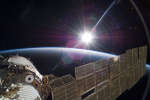
This was just one more breathtaking view from the International Space Station. The Sun, a crescent Earth, and the long arm of a solar panel were all visible outside a window when the Space Shuttle Atlantis visited the orbiting outpost last week. Reflections from the window and hexagonal lens flares from the camera are superposed.
|
January February March April May June July August September |
|||||||||||||||||||||||||||||||||||||||||||||||||