
|
You entered: orbit
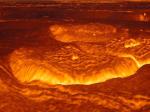 Venus Once Molten Surface
10.04.2005
If you could look at Venus with radar eyes - this is what you might see. This computer reconstruction of the surface of Venus was created from data from the Magellan spacecraft. Magellan orbited Venus and used radar to map our neighboring planet's surface between 1990 and 1994.
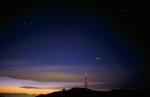 An Iridium Flash Sunset
2.05.2000
Did you see that flash? Lasting only about 15 seconds, it's possible that nobody you ask can confirm it, but what you might have seen is sunlight reflecting off an orbiting Iridium satellite. Satellites of all types have been providing streaks and glints visible only since the launch of Sputnik I in 1957.
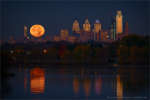 Philadelphia Perigee Full Moon
18.11.2016
A supermoon sets over the metropolis of Philadelphia in this twilight snapshot captured on November 14 at 6:21am Eastern Standard Time. Within hours of the Moon's exact full phase, that time does correspond to a lunar perigee or the closest point in the Moon's elliptical orbit around our fair planet.
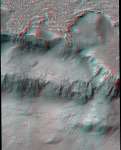 3D Lava Falls of Mars
1.07.2017
Get out your red/cyan glasses and gaze across lava falls of Mars. The stereo anaglyph was created by combining two images recorded by the HiRISE camera onboard Mars Reconnaissance Orbiter. The multi-level falls were...
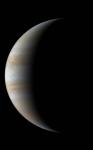 Farewell Jupiter
9.03.2003
Next stop: Saturn. The Cassini spacecraft, launched from Earth in 1997, has now swung past Jupiter and should arrive at Saturn in the year 2004. Pictured to the left is a parting shot from Cassini in January that would not have been possible from Earth: Jupiter showing a crescent phase.
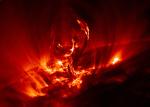 A Solar Filament Lifts Off
25.07.2004
Hot gas frequently erupts from the Sun. One such eruption produced the glowing filament pictured above, which was captured in 2000 July by the Earth-orbiting TRACE satellite. The filament, although small compared...
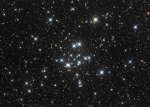 Star Cluster M34
11.02.2010
This pretty open cluster of stars, M34, is about the size of the Full Moon on the sky. Easy to appreciate in small telescopes, it lies some 1,800 light-years away in the constellation Perseus. At that distance, M34 physically spans about 15 light-years.
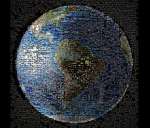 Earth Waves at Saturn
24.08.2013
This friendly photo collage is constructed from more than 1,400 images shared by denizens of planet Earth as part of the Cassini Mission's July 19th Wave at Saturn event. The base picture...
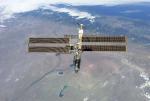 A Space Station Meets its Destiny
28.02.2001
The International Space Station (ISS) had a date with Destiny earlier this month. More specifically, the crew of the Space Shuttle Atlantis installed the science laboratory named Destiny on the ISS. Destiny, pictured here, will also serve as a control center for the Earth orbiting space station.
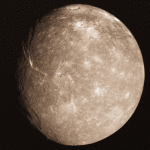 Uranus' Largest Moon: Titania
4.03.1996
Titania's tortured terrain is a mix of valleys and craters. NASA's interplanetary robot spacecraft Voyager 2 passed this moon of Uranus in 1986 and took the above photograph. The photograph was then transmitted back to earth by radio.
|
January February March April May June July August September |
|||||||||||||||||||||||||||||||||||||||||||||||||