
|
You entered: orbit
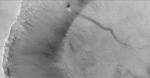 A Dust Devil on Mars
3.09.2002
Does the surface of Mars change? When inspecting yearly images of the Martian surface taken by the robot spacecraft Mars Global Surveyor currently orbiting Mars, sometimes new dark trails are visible. Although originally...
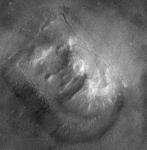 Return To Cydonia
7.04.1998
Yesterday the Mars Global Surveyor project released a new close-up image of a portion of the Cydonia region on Mars. This cropped and processed version shows an area about 2 miles wide (the full...
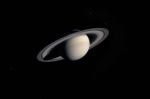 Cassini Approaches Saturn
10.12.2003
Cassini, a robot spacecraft launched in 1997 by NASA, is close enough now to resolve many rings and moons of its destination planet: Saturn. The spacecraft has now closed to within a single Earth-Sun separation from the ringed giant. Early last month, Cassini snapped the contrast-enhanced color composite pictured above.
 A Mars Panorama from the Spirit Rover
14.01.2004
If you could stand on Mars -- what would you see? Scrolling right will reveal a full color 360-degree panoramic view from NASA's Spirit Rover that landed on Mars just 10 days ago. The image is a digital mosaic from the panoramic camera that shows the view in every direction.
 M51: The Whirlpool Galaxy from Hubble
13.06.2022
The Whirlpool Galaxy is a classic spiral galaxy. At only 30 million light years distant and fully 60 thousand light years across, M51, also known as NGC 5194, is one of the brightest and most picturesque galaxies on the sky.
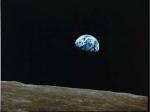 Earth Rise
27.01.2002
During 1968, the Apollo 8 crew flew from the Earth to the Moon and back. The crew, consisting of Frank Borman, James Lovell, and Willian Anders, were launched atop a Saturn V rocket on December 21, circled the Moon ten times in their command module, and landed back on Earth on December 27.
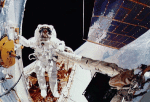 Repairing Hubble
16.11.1995
The first Hubble Space Telescope (HST) servicing mission, STS-61, was one of the most complicated shuttle missions ever planned. Launched on December 2, 1993 in the Space Shuttle Endeavor, the astronauts were required to make 5 space walks to repair the HST. Astronaut F.
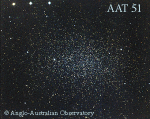 Nearby Dwarf Galaxy Leo I
19.05.1996
Leo I is a dwarf spheroidal galaxy in the Local Group of galaxies dominated by our Milky Way Galaxy and M31. Leo I is thought to be the most distant of the eleven known small satellite galaxies orbiting our Milky Way Galaxy.
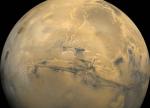 Valles Marineris: The Grand Canyon of Mars
27.08.2002
The largest canyon in the Solar System cuts a wide swath across the face of Mars. Named Valles Marineris, the grand valley extends over 3,000 kilometers long, spans as much as 600 kilometers across, and delves as much as 8 kilometers deep.
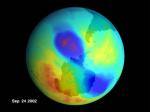 A Small Double Ozone Hole in 2002
22.10.2002
As expected, the ozone hole near Earth's South Pole is back again this year. This time, however, it's smaller than the past two years, and has an unusual double lobe structure. Ozone is important because it shields us from damaging ultraviolet sunlight.
|
January February March April May June July August September |
|||||||||||||||||||||||||||||||||||||||||||||||||