
|
You entered: orbit
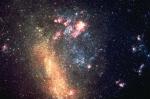 Neighboring Galaxy: The Large Magellanic Cloud
22.02.2000
The brightest galaxy visible from our own Milky Way Galaxy is the Large Magellanic Cloud (LMC). Visible predominantly from Earth's Southern Hemisphere, the LMC is the second closest galaxy, neighbor to the Small Magellanic Cloud, and one of eleven known dwarf galaxies that orbit our Milky Way Galaxy.
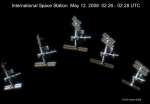 Space Station in the Sun
24.05.2008
Still bathed in sunlight, the International Space Station tracked through night skies above Hombressen, Germany on May 12. From a range of at least 360 kilometers, astronomer Dirk Ewers was able to record...
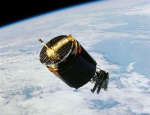 The Astronaut Who Captured a Satellite
9.12.2012
In 1984, high above the Earth's surface, an astronaut captured a satellite. It was the second satellite captured that mission. Pictured above, astronaut Dale A. Gardner flies free using the Manned Maneuvering Unit and begins to attach a control device dubbed the Stinger to the rotating Westar 6 satellite.
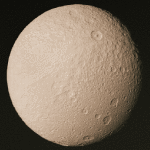 Saturn's Moon Tethys
24.11.1995
Tethys is one of the larger and closer moons of Saturn. It was visited by both Voyager spacecraft - Voyager 1 in November 1980 and by Voyager 2 in August 1981. Tethys is now known to be composed almost completely of water ice. Tethys shows a large impact crater that nearly circles the planet.
 Mars in the New Year
6.01.2000
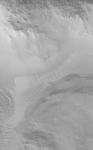
Many will long remember where they were and what they were doing when the calendar rolled over to the year 2000. On Mars, of course, that date was nothing special and the Mars Global Surveyor spacecraft continued with business as usual - systematically recording images of the Red Planet from orbit.
 The International Space Station Expands Again
5.03.2008
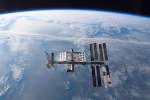
The developing International Space Station (ISS) has changed its appearance again. Last month, the Space Shuttle orbiter Atlantis visited the ISS and added components that included the Columbus Science Laboratory. The entire array of expansive solar panels is visible in this picture taken by the Atlantis Crew after leaving the ISS to return to Earth.
 Lyrid of the Lake
28.04.2022
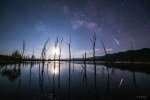
In the early hours of April 24 this bright Lyrid meteor flashed along the central Milky Way. For a moment, it cast a bright reflection across Lake Nian, Yunnan province, China. The annual Lyrid...
 Layers of the Martian South Polar Cap
25.04.2000
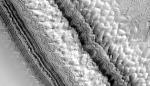
The South Pole of Mars is stranger than was previously thought. Pictured above are unexpectedly complex layers photographed recently by the Mars Global Surveyor spacecraft currently orbiting Mars. The layers probably include carbon dioxide ice, water ice, rock and dust.
 Martian Crater Shows Evidence of Dried Pond
3.06.1998
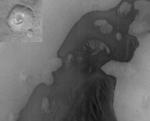
Did a pond once exist in this Martian crater? Recent photographs by the spacecraft Mars Global Surveyor, currently in orbit around Mars, show features unusual for Mars yet similar to a dried pond on Earth.
 Apollo 14 on the Moon
9.12.1995
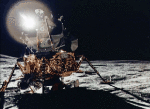
The jewel-like glare from a brilliant sun reflects off the lunar module of the Apollo 14 mission to the Moon as it rests on the lunar surface in February 1971. Astronauts Alan Shepard and Edgar Mitchell walked on the Moon's surface while astronaut Stuart Roosa piloted the orbiting command module.
|
January February March April May June July August September |
|||||||||||||||||||||||||||||||||||||||||||||||||