
|
You entered: orbit
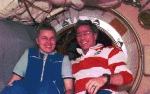 Welcome Home Shannon Lucid
27.09.1996
Today is Shannon Lucid's first day on Planet Earth in six months. Her stay aboard Russia's Mir Space Station was of record length - the longest stay of any American in space ever.
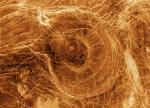 Arachnoids on Venus
20.01.1998
Arachnoids are large structures of unknown origin that have been found only on the surface of Venus. Arachnoids get their name from their resemblance to spider-webs. They appear as concentric ovals surrounded by a complex network of fractures, and can span 200 kilometers.
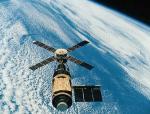 Skylab Over Earth
28.05.2000
Skylab was an orbiting laboratory launched by a Saturn V rocket in May 1973. Skylab was visited three times by NASA astronauts who sometimes stayed as long as two and a half months. Many scientific tests were performed on Skylab, including astronomical observations in ultraviolet and X-ray light.
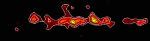 Radioactive Clouds in the Milky Way
29.10.1995
When massive stars explode they create large radioactive blast clouds which expand into interstellar space. As the radioactive elements decay, they produce gamma-rays. Possible locations of these stellar explosions known as supernovae, are indicated by the bright clumps in this map of the central regions of our Milky Way Galaxy.
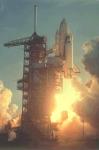 Liftoff of Space Shuttle Columbia
11.04.1999
On April 12, 1981, space flight entered a new era with the first launch of Space Shuttle Columbia. NASA's Space Shuttles land like a normal airplane, carry a heavy cargo, carry a large crew, make use of cheap solid fuel, and are reusable.
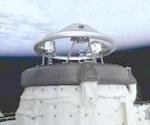 The Space Shuttle Docking Ring
18.10.2000
A space shuttle is again visiting the International Space Station (ISS). The STS-92 crew aboard Discovery have already delivered and installed a truss and a docking port on the growing orbiting space station. The station is being prepared for its first permanent crew, currently scheduled to be launched from Kazakstan on October 30.
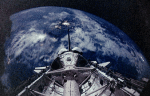 Lightning Below
2.12.1995
In May of 1993, the Space Shuttle Columbia orbited the Earth carrying the Spacelab Deutsche 2 (SL-D
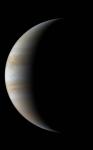 Farewell Jupiter
8.08.2001
Next stop: Saturn. The Cassini spacecraft, launched from Earth four years ago, has now swung past Jupiter and should arrive at Saturn in the year 2004. Pictured to the left is a parting shot from Cassini in January that would not have been possible from Earth: Jupiter showing a crescent phase.
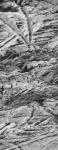 560 Kilometers Above Europa
3.03.1998
This is the closest photograph ever taken of Europa. Last December, NASA's spacecraft Galileo swept past the Jovian moon and took photographs which were released yesterday. Speculation that life-bearing oceans exist beneath Europa's surface caused NASA to put Galileo on orbits that approach Europa.
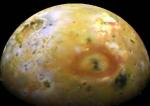 Io's Giant Volcano Pele
5.12.1996
Io has some very large volcanoes. One of the largest is evident near the center of the above photograph and named Pele, for the mythological Polynesian fire goddess. The Galileo spacecraft now orbiting Jupiter took this picture of Jupiter's most active moon in June, although it was released just last week.
|
January February March April May June July August September |
|||||||||||||||||||||||||||||||||||||||||||||||||