
|
You entered: NASA
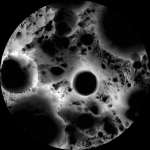 Shadows at the Lunar South Pole
23.04.2011
What is it? It's a multi-temporal illumination map, of course. To make it, the wide angle camera on the Lunar Reconnaissance Orbiter spacecraft collected 1,700 images over a period of 6 lunar days (6 Earth months), repeatedly covering an area centered on the Moon's south pole.
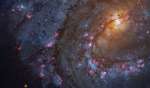 In the Arms of M83
11.11.2011
Big, bright, and beautiful, spiral galaxy M83 lies a mere twelve million light-years away, near the southeastern tip of the very long constellation Hydra. This cosmic close-up, a mosaic based on data from...
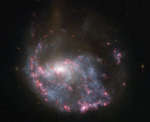 NGC 922: Collisional Ring Galaxy
17.12.2012
Why does this galaxy have so many big black holes? No one is sure. What is sure is that NGC 922 is a ring galaxy created by the collision of a large and small galaxy about 300 million years ago.
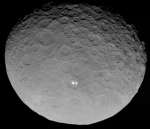 Dwarf Planet, Bright Spot
14.05.2015
Now at Ceres, Dawn's camera recorded this closer view of the dwarf planet's northern hemisphere and one of its mysterious bright spots on May 4. A sunlit portrait of a small, dark...
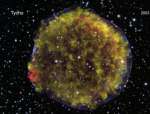 Tychos Supernova Remnant Expands
1.06.2016
What star created this huge expanding puffball? Featured here is the first expansion movie ever created for Tycho's supernova remnant, the result of a stellar explosion first recorded over 400 years ago by the famous astronomer Tycho Brahe.
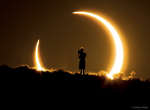 Annular Solar Eclipse over New Mexico
31.08.2016
What is this person doing? In 2012 an annular eclipse of the Sun was visible over a narrow path that crossed the northern Pacific Ocean and several western US states. In an annular solar...
 NGC 2392: Double Shelled Planetary Nebula
16.02.2020
To some, this huge nebula resembles a person's head surrounded by a parka hood. In 1787, astronomer William Herschel discovered this unusual planetary nebula: NGC 2392. More recently, the Hubble Space Telescope imaged the nebula in visible light, while the nebula was also imaged in X-rays by the Chandra X-ray Observatory.
 APOD: 2020 July 26 Б A Flight through the Hubble Ultra Deep Field
26.07.2020
What would it look like to fly through the distant universe? To find out, a team of astronomers estimated the relative distances to over 5,000 galaxies in one of the most distant fields of galaxies ever imaged: the Hubble Ultra Deep Field (HUDF).
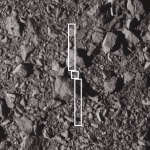 DART vs Dimorphos
9.03.2023
On the first planetary defense test mission from planet Earth, the DART spacecraft captured this close-up on 26 September 2022, three seconds before slamming into the surface of asteroid moonlet Dimorphos. The spacecraft's outline with two long solar panels is traced at its projected point of impact between two boulders.
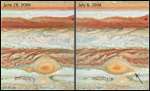 When Storms Collide
24.07.2008
These detailed Hubble Space Telescope close-ups feature Jupiter's ancient swirling storm system known as the Great Red Spot. They also follow the progress of two newer storm systems that have grown to take on a similar reddish hue: the smaller "Red Spot Jr." (bottom), and smaller still, a "baby red spot". Red Spot Jr.
|
January February March April May June July August September |
|||||||||||||||||||||||||||||||||||||||||||||||||