
|
You entered: NASA
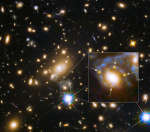 Galaxy and Cluster Create Four Images of Distant Supernova
8.03.2015
What are the unusual spots surrounding that galaxy? They are all images of the same supernova. For the first time, a single supernova explosion has been seen split into multiple images by the gravitational lens deflections of intervening masses. In this case the masses are a large galaxy and its home galaxy cluster.
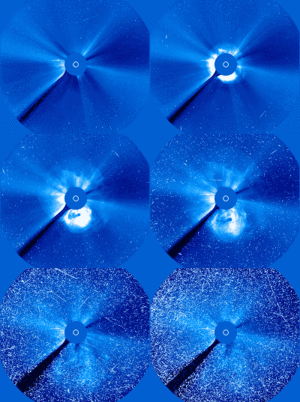 A Powerful Solar Flare
1.09.2018
It was one of the most powerful solar flares in recorded history. Occurring in 2003 and seen across the electromagnetic spectrum, the Sun briefly became over 100 times brighter in X-rays than normal.
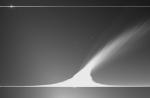 The Iron Tail of Comet McNaught
4.05.2007
Outstanding in planet Earth's sky early this year, Comet McNaught is captured in this view from the STEREO A spacecraft. McNaught's coma is so bright, it blooms into the long horizontal stripe at the bottom of the field.
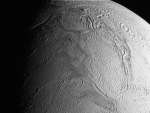 Cassini Passes Through Ice Plumes of Enceladus
13.10.2008
What telling impurities taint the ice plumes of Enceladus? To help answer this question, the robotic Cassini spacecraft dove last week to within 30 kilometers of Saturn's ice-plume emitting moon. At this closest-ever...
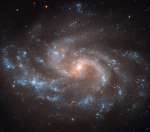 NGC 5584: Expanding the Universe
30.03.2011
Big, beautiful NGC 5548 is more that 50,000 light-years across and lies 72 million light-years away toward the constellation Virgo. The winding spiral arms of this gorgeous island universe are loaded with luminous young star clusters and dark dust lanes. Still, for earthbound astronomers NGC 5548 is not just another pretty face-on spiral galaxy.
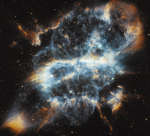 NGC 5189: An Unusually Complex Planetary Nebula
19.12.2012
Why is this nebula so complex? When a star like our Sun is dying, it will cast off its outer layers, usually into a simple overall shape. Sometimes this shape is a sphere, sometimes a double lobe, and sometimes a ring or a helix.
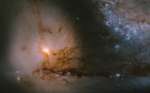 NGC 5195: The Dot under the Question Mark
31.08.2013
Dwarf galaxy NGC 5195 is best known as the smaller companion of spiral M51, the Whirlpool galaxy. Seen together they seem to trace the curve and dot of a cosmic question mark, recorded in Lord Rosse's 19th century drawings as one of the original spiral nebulae.
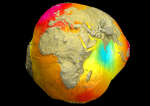 The Potsdam Gravity Potato
14.12.2014
Why do some places on Earth have higher gravity than others? Sometimes the reason is unknown. To help better understand the Earth's surface, sensitive measurments by the orbiting satellites GRACE and CHAMP were used to create a map of Earth's gravitational field.
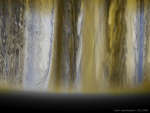 Jupiters Clouds from New Horizons
25.06.2016
The New Horizons spacecraft took some stunning images of Jupiter on its way out to Pluto. Famous for its Great Red Spot, Jupiter is also known for its regular, equatorial cloud bands, visible through even modest sized telescopes.
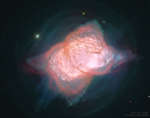 Bright Planetary Nebula NGC 7027 from Hubble
8.01.2018
It is one of the brightest planetary nebulae on the sky -- what should it be named? First discovered in 1878, nebula NGC 7027 can be seen toward the constellation of the Swan (Cygnus) with a standard backyard telescope.
|
January February March April May June July August September |
|||||||||||||||||||||||||||||||||||||||||||||||||