
|
You entered: NASA
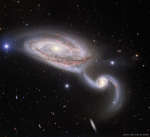 The Slow Dance of Galaxies NGC 5394 and 5395
4.03.2020
If you like slow dances, then this may be one for you. A single turn in this dance takes several hundred million years. Two galaxies, NGC 5394 and NGC 5395, slowly whirl about each other in a gravitational interaction that sets off a flourish of sparks in the form of new stars.
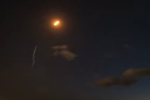 Streak and Plume from SpaceX Crew2 Launch
24.04.2021
What's happening in the sky? The pre-dawn sky first seemed relatively serene yesterday morning over Indian Harbor Beach in Florida, USA. But then it lit up with a rocket launch. Just to the north, NASA's SpaceX Crew-2 Mission blasted into space aboard a powerful Falcon 9 rocket.
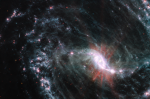 Barred Spiral Galaxy NGC 1365 from Webb
18.02.2023
A mere 56 million light-years distant toward the southern constellation Fornax, NGC 1365 is an enormous barred spiral galaxy about 200,000 light-years in diameter. That's twice the size of our own barred spiral Milky Way.
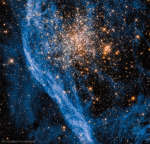 APOD: 2023 February 20 Б NGC 1850: Not Found in the Milky Way
20.02.2023
There is nothing like this ball of stars in our Milky Way Galaxy. This is surprising because, at first glance, this featured image by the Hubble Space Telescope suggests that star cluster NGC 1850...
 Unwinding M51
6.04.2024
The arms of a grand design spiral galaxy 60,000 light-years across are unwound in this digital transformation of the magnificent 2005 Hubble Space Telescope portrait of M51. In fact...
 Barred Spiral Galaxy NGC 1365 from Webb
13.11.2024
A mere 56 million light-years distant toward the southern constellation Fornax, NGC 1365 is an enormous barred spiral galaxy about 200,000 light-years in diameter. That's twice the size of our own barred spiral Milky Way.
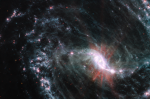 Barred Spiral Galaxy NGC 1365 from Webb
21.01.2026
A mere 56 million light-years distant toward the southern constellation Fornax, NGC 1365 is an enormous barred spiral galaxy about 200,000 light-years in diameter. That's twice the size of our own barred spiral Milky Way.
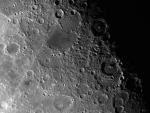 Impact Moon
26.03.1999
The Moon's surface is covered with craters, scars of frequent impacts during the early history of the solar system. Now, recent results from the Lunar Prospector spacecraft support the idea that the Moon itself formed from the debris of a giant impact of a mars-sized planetary body with the
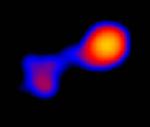 Mira: The Wonderful Star
22.07.2006
To seventeenth century astronomers, Omicron Ceti or Mira was known as a wonderful star - a star whose brightness could change dramatically in the course of about 11 months. Modern astronomers now recognize an entire class of long period Mira-type variables as cool, pulsating, red giant stars, 700 or so times the diameter of the Sun.
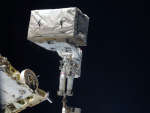 Astronauts Head Upgraded During Spacewalk
1.04.2009
First, a new truss was added. Then, new solar panels were installed. Now, as part of the planned upgrade of the International Space Station, an Expedition 18 astronaut has upgraded her own head.
|
January February March April May June July August September |
|||||||||||||||||||||||||||||||||||||||||||||||||