
|
You entered: NASA
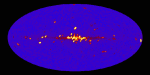 The X-Ray Sky
2.01.1996
What if you could see X-rays? If you could, the night sky would be a strange and unfamiliar place. X-rays are about 1,000 times more energetic than visible light photons and are produced in violent and high temperature astrophysical environments.
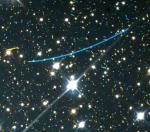 Asteroids in the Distance
16.03.1998
Rocks from space hit Earth every day. The larger the rock, though, the less often Earth is struck. Many kilograms of space dust pitter to Earth daily. Larger bits appear initially as a bright meteor. Baseball-sized rocks and ice-balls streak through our atmosphere daily, most evaporating quickly to nothing.
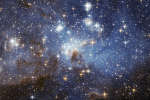 Star Forming Region LH 95
12.03.2008
How do stars form? To better understand this complex and chaotic process, astronomers used the Hubble Space Telescope to image in unprecedented detail the star forming region LH 95 in the nearby Large Magellanic Cloud galaxy.
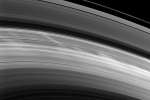 Spokes Reappear on Saturns Rings
2.06.2009
What causes the mysterious spokes in Saturn's rings? Visible in the above image as light ghostlike impressions, spokes were first discovered by the Voyager spacecraft that buzzed by Saturn in the early 1980s. Their existence was unexpected.
 Farther Along
6.05.2011
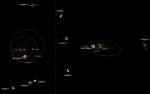
What is humanity's most distant spacecraft? Launched in 1977, Voyager 1 now holds that distinction at 17.5 billion kilometers from the Sun. That corresponds to 16 light-hours or 117 Astronomical Units (AU). This...
 Perseid Below
17.08.2011
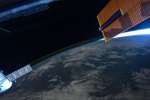
Denizens of planet Earth watched this year's Perseid meteor shower by looking up into the moonlit night sky. But this remarkable view captured by astronaut Ron Garan looks down on a Perseid meteor.
 A Horseshoe Einstein Ring from Hubble
21.12.2011
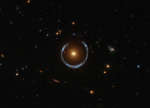
What's large and blue and can wrap itself around an entire galaxy? A gravitational lens mirage. Pictured above, the gravity of a luminous red galaxy (LRG) has gravitationally distorted the light from a much more distant blue galaxy.
 M106 Across the Spectrum
5.07.2014
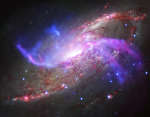
The spiral arms of bright, active galaxy M106 sprawl through this remarkable multiwavelength portrait, composed of image data from radio to X-rays, across the electromagnetic spectrum. Also known as NGC 4258, M106 can be found toward the northern constellation Canes Venatici.
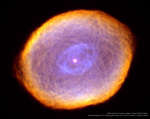 IC 418: The Spirograph Nebula
11.06.2017
What is creating the strange texture of IC 418? Dubbed the Spirograph Nebula for its resemblance to drawings from a cyclical drawing tool, planetary nebula IC 418 shows patterns that are not well understood. Perhaps they are related to chaotic winds from the variable central star, which changes brightness unpredictably in just a few hours.
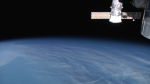 A Live View from the International Space Station
2.06.2019
If you were floating above the Earth right now, this is what you might see. In 2014, a robotic SpaceX Dragon capsule that delivered supplies to the Earth-orbiting International Space Station (ISS) also delivered High Definition Earth Viewing (HDEV) cameras that take and transmit live views of Earth.
|
January February March April May June July August September |
|||||||||||||||||||||||||||||||||||||||||||||||||