
|
You entered: NASA
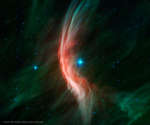 Zeta Oph: Runaway Star
7.04.2017
Like a ship plowing through cosmic seas, runaway star Zeta Ophiuchi produces the arcing interstellar bow wave or bow shock seen in this stunning infrared portrait. In the false-color view, bluish Zeta...
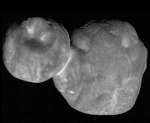 Sharpest Ultima Thule
27.02.2019
On January 1, New Horizons swooped to within 3,500 kilometers of the Kuiper Belt world known as Ultima Thule. That's about 3 times closer than its July 2015 closest approach to Pluto.
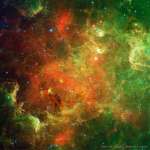 The North America Nebula in Infrared
27.07.2019
The North America Nebula can do what most North Americans cannot -- form stars. Precisely where in the nebula these stars are forming has been mostly obscured by some of the nebula's thick dust that is opaque to visible light.
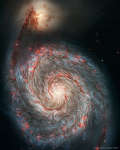 The Magnetic Field of the Whirlpool Galaxy
19.01.2021
Do magnetic fields always flow along spiral arms? Our face-on view of the Whirlpool Galaxy (M51) allows a spectacularly clear view of the spiral wave pattern in a disk-shaped galaxy. When observed with a radio telescope, the magnetic field appears to trace the arms' curvature.
 APOD: 2025 April 27 Б IC 418: The Spirograph Nebula
26.04.2025
What is creating the strange texture of IC 418? Dubbed the Spirograph Nebula for its resemblance to drawings from a cyclical drawing tool, planetary nebula IC 418 shows patterns that are not well understood. Perhaps they are related to chaotic winds from the variable central star, which changes brightness unpredictably in just a few hours.
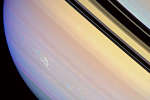 A Persistent Electrical Storm on Saturn
5.05.2008
How do large storms evolve on Saturn? On Earth, a hurricane can persist for weeks, while the Great Red Spot on Jupiter has been in existence for over 150 years. On Saturn, a storm system has now set a new endurance record, now being discernable for greater than three months.
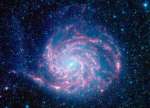 Spitzer s M101
25.07.2008
Big, beautiful spiral galaxy M101 is one of the last entries in Charles Messier's famous catalog, but definitely not one of the least. About 170,000 light-years across, this galaxy is enormous, almost twice the size of our own Milky Way Galaxy.
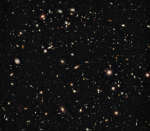 HUDF Infrared: Dawn of the Galaxies
8.12.2009
When did galaxies form? To help find out, the deepest near-infrared image of the sky ever has been taken of the same field as the optical-light Hubble Ultra Deep Field (HUDF) in 2004. The new image was taken this summer by the newly installed Wide Field Camera 3 on the refurbished Hubble Space Telescope.
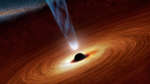 Spin up of a Supermassive Black Hole
12.03.2013
How fast can a black hole spin? If any object made of regular matter spins too fast -- it breaks apart. But a black hole might not be able to break apart -- and its maximum spin rate is really unknown.
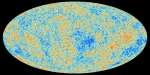 Planck Maps the Microwave Background
25.03.2013
What is our universe made of? To help find out, ESA launched the Planck satellite to map, in unprecedented detail, slight temperature differences on the oldest surface known -- the background sky left billions of years ago when our universe first became transparent to light.
|
January February March April May June July August September |
|||||||||||||||||||||||||||||||||||||||||||||||||