
|
You entered: NASA
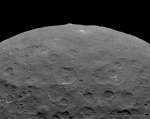 An Unusual Mountain on Asteroid Ceres
30.06.2015
What created this large mountain on asteroid Ceres? No one is yet sure. As if in anticipation of today being Asteroid Day on Earth, the robotic spacecraft Dawn in orbit around Ceres took the best yet image of an unusually tall mountain on the Asteroid Belt's largest asteroid.
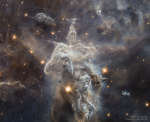 Mystic Mountain Monster being Destroyed
25.05.2020
Inside the head of this interstellar monster is a star that is slowly destroying it. The huge monster, actually an inanimate series of pillars of gas and dust, measures light years in length.
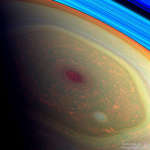 Saturns Northern Hexagon
5.07.2020
Why would clouds form a hexagon on Saturn? Nobody is sure. Originally discovered during the Voyager flybys of Saturn in the 1980s, nobody has ever seen anything like it anywhere else in the Solar System.
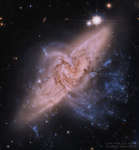 NGC 3314: When Galaxies Overlap
17.11.2021
Why doesn't the nearby galaxy create a gravitational lensing effect on the background galaxy? It does, but since both galaxies are so nearby, the angular shift is much smaller than the angular sizes of the galaxies themselves.
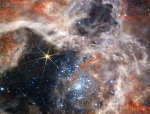 Tarantula Stars R136 from Webb
7.09.2022
Near the center of a nearby star-forming region lies a massive cluster containing some of the largest and hottest stars known. Collectively known as star cluster NGC 2070, these stars are part of the vast Tarantula Nebula and were captured in two kinds of infrared light by the new Webb Space Telescope.
 Supernova Remnant Cassiopeia A
17.01.2025
Massive stars in our Milky Way Galaxy live spectacular lives. Collapsing from vast cosmic clouds, their nuclear furnaces ignite and create heavy elements in their cores. After only a few million years for the most massive stars, the enriched material is blasted back into interstellar space where star formation can begin anew.
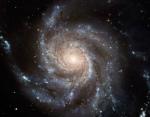 Messier 101
2.03.2006
Big, beautiful spiral galaxy M101 is one of the last entries in Charles Messier's famous catalog, but definitely not one of the least. About 170,000 light-years across, this galaxy is enormous, almost twice the size of our own Milky Way galaxy.
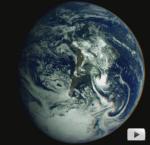 Rotating Earth from Galileo
14.05.2007
When passing Earth on your way to Jupiter, what should you look for? That question arose for the robotic Galileo spacecraft that soundlessly coasted past the Solar System's most photographed orb almost two decades ago.
 Cat s Eye Hubble Remix
22.03.2008
Staring across interstellar space, the alluring Cat's Eye Nebula lies three thousand light-years from Earth. One of the most famous planetary nebulae in the sky, the Cat's Eye (NGC 6543) is over half a light-year across and represents a final, brief yet glorious phase in the life of a sun-like star.
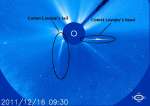 Comet Lovejoy: Sungrazing Survivor
17.12.2011
Like most other sungrazing comets, Comet Lovejoy (C/2011 W3) was not expected to survive its close encounter with the Sun. But it did. This image from a coronograph onboard the sun-staring SOHO spacecraft identifies the still inbound remnants of the tail, with the brilliant head or coma emerging from the solar glare on December 16.
|
January February March April May June July August September |
|||||||||||||||||||||||||||||||||||||||||||||||||