
|
You entered: NASA
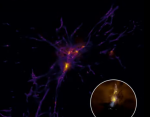 Simulation: Formation of the First Stars
30.06.2021
How did the first stars form? To help find out, the SPHINX computer simulation of star formation in the very early universe was created, some results of which are shown in the featured video. Time since the Big Bang is shown in millions of years on the upper left.
 APOD: 2024 January 7 Б The Cats Eye Nebula in Optical and X-ray
7.01.2024
To some it looks like a cat's eye. To others, perhaps like a giant cosmic conch shell. It is actually one of the brightest and most highly detailed planetary nebula known, composed of gas expelled in the brief yet glorious phase near the end of life of a Sun-like star.
 Solar System Family Portrait
13.07.2024
In 1990, cruising four billion miles from the Sun, the Voyager 1 spacecraft looked back to make this first ever Solar System family portrait. The complete portrait is a 60 frame mosaic made from a vantage point 32 degrees above the ecliptic plane.
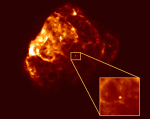 Supernova Remnant and Neutron Star
25.04.1998
A massive star ends life as a supernova, blasting its outer layers back to interstellar space. The spectacular death explosion is initiated by the collapse of what has become an impossibly dense stellar core. However, this core is not necessarily destroyed.
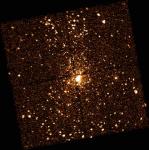 X-Ray Stars Of Orion
4.02.2000
The stars of Orion shine brightly in northern winter skies where the constellation harbors the closest large stellar nursery, the Great Nebula of Orion, a mere 1500 light-years away. In fact, the apparently bright...
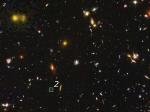 Building Galaxies in the Early Universe
10.09.2007
What was the very early universe like? To help find out, astronomers pointed the Hubble Space Telescope between bright nearby objects to create one of the deepest images ever -- the Hubble Ultra Deep Field (HUDF). The resulting HUDF is like a jewel box of strange and distant galaxies.
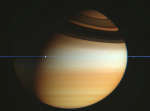 Cassini Spacecraft Crosses Saturn's Ring Plane
15.02.2010
If this is Saturn, where are the rings? When Saturn's "appendages" disappeared in 1612, Galileo did not understand why. Later that century, it became understood that Saturn's unusual protrusions were rings and that when the Earth crosses the ring plane, the edge-on rings will appear to disappear.
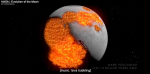 Evolution of the Moon
20.03.2012
What is the history of the Moon? The Moon was likely created from debris expelled when a Mars-sized object violently impacted the Earth about 4.5 billion years ago. Just after gravitationally condensing, as imagined above, the glowing-hot surface of the Moon cooled and cracked.
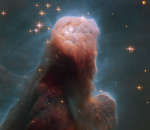 The Cone Nebula from Hubble
28.05.2014
Stars are forming in the gigantic dust pillar called the Cone Nebula. Cones, pillars, and majestic flowing shapes abound in stellar nurseries where natal clouds of gas and dust are buffeted by energetic winds from newborn stars. The Cone Nebula, a well-known example, lies within the bright galactic star-forming region NGC 2264.
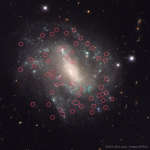 The Supernova and Cepheids of Spiral Galaxy UGC 9391
6.06.2016
What can this galaxy tell us about the expansion rate of the universe? Perhaps a lot because UGC 9391, featured, not only contains Cepheid variable stars (red circles) but also a recent Type Ia supernova (blue X).
|
January February March April May June July August September |
|||||||||||||||||||||||||||||||||||||||||||||||||