
|
You entered: NASA
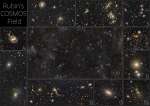 Rubin's COSMOS Field
6.08.2026
There are more than half a million galaxies in the central panel of this image from the NSF-DOE Vera C. Rubin Observatory in Chile. This is the COSMOS field, a patch of sky several times larger than the full moon, first observed by Hubble.
 The Colors of Comet Hyakutake
28.03.1996
The colors of Comet Hyakutake are caused by the action of sunlight on the dust and gas produced by the warming nucleus. The microscopic dust particles reflect sunlight while the sun's ultraviolet radiation excites and ionizes the gas molecules causing them to glow or fluoresce in a range of visible colors.
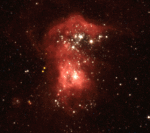 Bright Stars, Dim Galaxy
14.10.1996
These two clusters of bright, newly formed stars surrounded by a glowing nebula lie 10 million light years away in the dim, irregular galaxy cataloged as NGC 2366. The Hubble Space Telescope image shows...
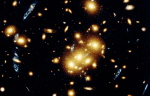 Giant Cluster Bends, Breaks Galaxy Images
3.05.1997
What are those strange blue objects? Many are images of a single, unusual, beaded, blue, ring-like galaxy which just happens to line-up behind a giant cluster of galaxies. Cluster galaxies here appear yellow and -- together with the cluster's dark matter -- act as a gravitational lens.
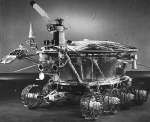 Lunokhod: Reflections on a Moon Robot
6.06.2010
It may look like some sort of cute alien robot, but it was created here on Earth, launched to the Moon in 1970, and now reflects laser light in a scientifically useful way. On November 17, 1970 the Soviet Luna 17 spacecraft landed the first roving remote-controlled robot on the Moon.
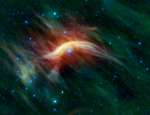 Zeta Oph: Runaway Star
3.02.2011
Like a ship plowing through cosmic seas, runaway star Zeta Ophiuchi produces the arcing interstellar bow wave or bow shock seen in this stunning infrared portrait from the WISE spacecraft. In the false-color view...
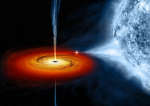 Heavy Black Hole Jets in 4U1630 47
20.11.2013
What are black hole jets made of? Many black holes in stellar systems are surely surrounded by disks of gas and plasma gravitationally pulled from a close binary star companion. Some of this material...
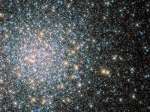 Hubble s Messier 5
25.04.2014
"Beautiful Nebula discovered between the Balance [Libra] & the Serpent [Serpens] ..." begins the description of the 5th entry in 18th century astronomer Charles Messier's famous catalog of nebulae and star clusters. Though it appeared...
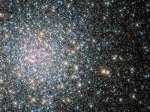 Hubble s Messier 5
19.06.2015
"Beautiful Nebula discovered between the Balance [Libra] & the Serpent [Serpens] ..." begins the description of the 5th entry in 18th century astronomer Charles Messier's famous catalog of nebulae and star clusters. Though it appeared...
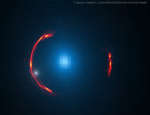 Galaxy Einstein Ring
19.04.2016
Can one galaxy hide behind another? Not in the case of SDP.81. Here the foreground galaxy, shown in blue in an image taken by the Hubble Space Telescope, acts like a huge gravitational...
|
January February March April May June July August September |
|||||||||||||||||||||||||||||||||||||||||||||||||