
|
You entered: NASA
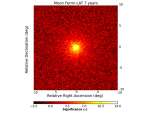 Fermi s Gamma-ray Moon
29.04.2016
If you could only see gamma-rays, photons with up to a billion or more times the energy of visible light, the Moon would be brighter than the Sun! That startling notion underlies this novel...
 APOD: 2024 February 4 Б The Cone Nebula from Hubble
4.02.2024
Stars are forming in the gigantic dust pillar called the Cone Nebula. Cones, pillars, and majestic flowing shapes abound in stellar nurseries where natal clouds of gas and dust are buffeted by energetic winds from newborn stars. The Cone Nebula, a well-known example, lies within the bright galactic star-forming region NGC 2264.
 APOD: 2024 December 8 Б Aurora around Saturns North Pole
8.12.2024
Are Saturn's auroras like Earth's? To help answer this question, the Hubble Space Telescope and the Cassini spacecraft monitored Saturn's North Pole simultaneously during Cassini's final orbits around the gas giant in September 2017. During this time, Saturn's tilt caused its North Pole to be clearly visible from Earth.
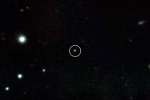 GRB 090423: The Farthest Explosion Yet Measured
29.04.2009
An explosion so powerful it was seen clear across the visible universe was recorded in gamma-radiation last week by NASA's orbiting Swift Observatory. Farther than any known galaxy, quasar, or optical supernova, the gamma-ray burst recorded last week was clocked at redshift 8.2, making it the farthest explosion of any type yet detected.
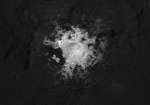 Cerealia Facula
19.07.2018
Cerealia Facula, also known as the brightest spot on Ceres, is shown in this stunning mosaic close-up view. The high-resolution image data was recorded by the Dawn spacecraft, in a looping orbit, from altitudes as low as 34 kilometers (21 miles) above the dwarf planet's surface.
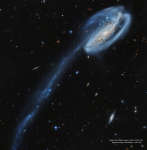 Arp 188 and the Tadpole's Tail
11.12.2018
Why does this galaxy have such a long tail? In this stunning vista, based on image data from the Hubble Legacy Archive, distant galaxies form a dramatic backdrop for disrupted spiral galaxy Arp 188, the Tadpole Galaxy. The cosmic tadpole is a mere 420 million light-years distant toward the northern constellation of the Dragon (Draco).
 Messier 101
27.11.2021
Big, beautiful spiral galaxy M101 is one of the last entries in Charles Messier's famous catalog, but definitely not one of the least. About 170,000 light-years across, this galaxy is enormous, almost twice the size of our own Milky Way.
 Messier 101
2.06.2023
Big, beautiful spiral galaxy M101 is one of the last entries in Charles Messier's famous catalog, but definitely not one of the least. About 170,000 light-years across, this galaxy is enormous, almost twice the size of our own Milky Way.
 Planet Earth from Orion
18.11.2023
One year ago a Space Launch System rocket left planet Earth on November 16, 2022 at 1:47am EST carrying the Orion spacecraft on the Artemis I mission, the first integrated test of NASAБs deep space exploration systems.
 Messier 101
16.05.2025
Big, beautiful spiral galaxy M101 is one of the last entries in Charles Messier's famous catalog, but definitely not one of the least. About 170,000 light-years across, this galaxy is enormous, almost twice the size of our own Milky Way.
|
January February March April May June July August September |
|||||||||||||||||||||||||||||||||||||||||||||||||