
|
You entered: NASA
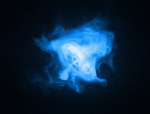 Crab Pulsar Wind Nebula
27.12.2008
The Crab Pulsar, a city-sized, magnetized neutron star spinning 30 times a second, lies at the center of this remarkable image from the orbiting Chandra Observatory. The deep x-ray image gives the first clear view of the convoluted boundaries of the Crab's pulsar wind nebula.
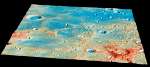 MESSENGER s Last Day on Mercury
1.05.2015
The first to orbit Mercury, the MESSENGER spacecraft came to rest on this region of Mercury's surface yesterday. Constructed from MESSENGER image and laser altimeter data, the scene looks north over the northeastern rim of the broad, lava filled Shakespeare basin.
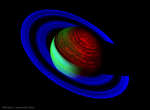 Neon Saturn
13.03.2016
If seen in the right light, Saturn glows like a neon sign. Although Saturn has comparatively little of the element neon, a composite image false-colored in three bands of infrared light highlights features of the giant ringed planet like a glowing sign.
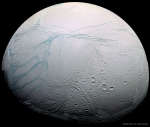 Fresh Tiger Stripes on Saturns Enceladus
27.04.2020
How will humanity first learn of extraterrestrial life? One possibility is to find it under the icy surface of Saturn's moon Enceladus. A reason to think that life may exist there are long features -- dubbed tiger stripes -- that are known to be spewing ice from the moon's icy interior into space.
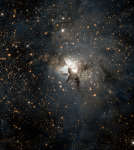 Central Lagoon in Infrared
19.03.2021
Stars fill this infrared view, spanning 4 light-years across the center of the Lagoon Nebula. Visible light images show the glowing gas and obscuring dust clouds that dominate the scene. But this infrared image...
 GRB 221009A
15.10.2022
Gamma-ray burst GRB 221009A likely signals the birth of a new black hole, formed at the core of a collapsing star long ago in the distant universe. The extremely powerful blast is depicted in this animated gif constructed using data from the Fermi Gamma Ray Space Telescope.
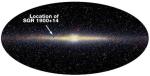 Magnetar In The Sky
2.10.1998
Indicated on this infrared image of the galactic center region is the position of SGR 1900+14 - the strongest known magnet in the galaxy. SGR 1900+14 is believed to be a city-sized, spinning, super-magnetic neutron star, or Magnetar. How strong is a Magnetar's magnetic field?
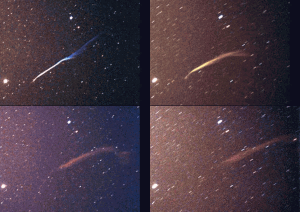 Meteor Storm Sights and Sounds
30.11.2001
This dramatic four-frame animation shows a fireball meteor and its developing persistent "smoke" train, recorded two weeks ago in skies near Salvador, Brazil. Indeed similar sights are astonishingly familiar world-wide to witnesses of this November's fireball-rich Leonid meteor storm.
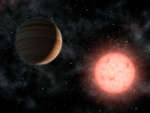 VB 10: A Large Planet Orbiting a Small Star
3.06.2009
Can a planet be as large as the star that it orbits? Recent observations have discovered that nearby Van Biesbroeck's star might have just such a large planet. Although VB 10 lies only...
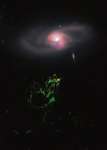 Hanny s Voorwerp
10.02.2011
Hanny's Voorwerp, Dutch for "Hanny's Object", is enormous, about the size of our own Milky Way Galaxy. Glowing strongly in the greenish light produced by ionized oxygen atoms, the mysterious voorwerp is below spiral galaxy IC 2497 in this view from the Hubble Space Telescope.
|
January February March April May June July August September |
|||||||||||||||||||||||||||||||||||||||||||||||||