
|
You entered: NASA
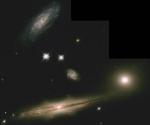 HCG 87: A Small Group of Galaxies
6.09.1999
Sometimes galaxies form groups. For example, our own Milky Way Galaxy is part of the Local Group of Galaxies. Small, compact groups, like Hickson Compact Group 87 (HCG 87) shown above, are interesting partly because they slowly self-destruct.
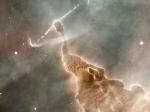 Dust Pillars of the Carina Nebula
30.04.2007
Inside the head of this interstellar monster is a star that is slowly destroying it. The monster, actually an inanimate pillar of gas and dust, measures over a light year in length. The star, not itself visible through the opaque dust, is bursting out partly by ejecting energetic beams of particles.
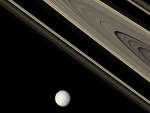 Saturn s Ancient Rings
16.12.2007
How old are Saturn's rings? No one is quite sure. One possibility is that the rings formed relatively recently in our Solar System's history, perhaps only about 100 million years ago when a moon-sized object broke up near Saturn.
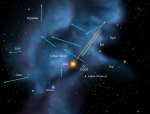 The Local Fluff
24.09.2013
The stars are not alone. In the disk of our Milky Way Galaxy about 10 percent of visible matter is in the form of gas, called the interstellar medium (ISM). The ISM is not uniform, and shows patchiness even near our Sun.
 APOD: 2023 April 2 Б M57: The Ring Nebula from Hubble
1.04.2023
It was noticed hundreds of years ago by stargazers who could not understand its unusual shape. It looked like a ring on the sky. Except for the rings of Saturn, the Ring Nebula (M57) may be the most famous celestial circle.
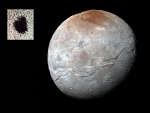 APOD: 2026 June 6 Б Charon: Moon of Pluto
5.06.2026
A darkened and mysterious north polar region known to some as Mordor Macula caps this premier view of Charon, Pluto's largest moon. The high-resolution image was captured by the interplanetary space probe New Horizons near its closest approach to distant Pluto on July 14, 2015.
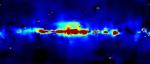 The Milky Way's Gamma-Ray Halo
4.11.1997
Our Milky Way galaxy appears to be surrounded by a halo of gamma rays. Gamma rays are the most energetic form of electromagnetic radiation, with more than a hundred thousand times the energy of visible light, but known gamma-ray sources don't account for the diffuse distribution of this high-energy glow.
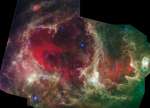 Generations of Stars in W5
29.08.2008
Giant star forming region W5 is over 200 light-years across and about 6,500 light-years away in the constellation Cassiopeia. W5's sculpted clouds of cold gas and dust seem to form fantastic shapes in this impressive mosaic of infrared images from the Spitzer Space Telescope.
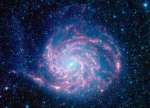 Spitzer s M101
29.12.2009
Big, beautiful spiral galaxy M101 is one of the last entries in Charles Messier's famous catalog, but definitely not one of the least. About 170,000 light-years across, this galaxy is enormous, almost twice the size of our own Milky Way Galaxy.
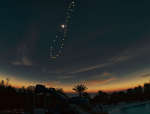 Tutulemma: Solar Eclipse Analemma
21.08.2016
If you went outside at exactly the same time every day and took a picture that included the Sun, how would the Sun's position change? With great planning and effort, such a series of images can be taken. The figure-8 path the Sun follows over the course of a year is called an analemma.
|
January February March April May June July August September |
|||||||||||||||||||||||||||||||||||||||||||||||||