
|
You entered: NASA
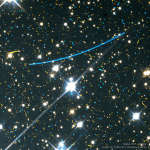 Asteroids in the Distance
30.01.2021
Rocks from space hit Earth every day. The larger the rock, though, the less often Earth is struck. Many kilograms of space dust pitter to Earth daily. Larger bits appear initially as a bright meteor. Baseball-sized rocks and ice-balls streak through our atmosphere daily, most evaporating quickly to nothing.
 APOD: 2023 July 5 Б A Map of the Observable Universe
4.07.2023
What if you could see out to the edge of the observable universe? You would see galaxies, galaxies, galaxies, and then, well, quasars, which are the bright centers of distant galaxies. To expand understanding...
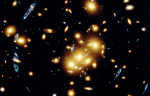 Giant Cluster Bends, Breaks Images
14.06.1998
What are those strange blue objects? Many are images of a single, unusual, beaded, blue, ring-like galaxy which just happens to line-up behind a giant cluster of galaxies. Cluster galaxies here appear yellow and -- together with the cluster's dark matter -- act as a gravitational lens.
 Thirteen Million Kilometers from Comet Tempel 1
29.06.2005
The Deep Impact spacecraft continues to close on Comet Tempel 1, a comet roughly the size of Manhattan. Early on July 3 (EDT), the Deep Impact spacecraft will separate in to two individual robotic spaceships, one called Flyby and the other called Impactor.
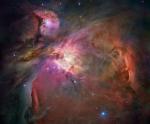 Orion Nebula, The Hubble View
18.01.2006
Few cosmic vistas excite the imagination like the Orion Nebula. Also known as M42, the nebula's glowing gas surrounds hot young stars at the edge of an immense interstellar molecular cloud only 1,500 light-years away.
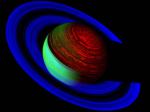 Neon Saturn
27.06.2007
If seen in the right light, Saturn glows like a neon sign. Although Saturn has comparatively little of the element neon, a composite image false-colored in three bands of infrared light highlights features of the giant ringed planet like a glowing sign.
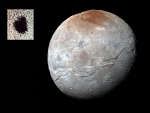 Charon: Moon of Pluto
5.07.2018
A darkened and mysterious north polar region known to some as Mordor Macula caps this premier high-resolution view. The portrait of Charon, Pluto's largest moon, was captured by New Horizons near the spacecraft's closest approach on July 14, 2015.
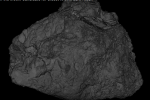 Found on the Moon: Candidate for Oldest Known Earth Rock
2.02.2021
Was the oldest known rock on Earth found on the Moon? Quite possibly. The story opens with the Apollo 14 lunar mission. Lunar sample 14321, a large rock found in Cone crater by astronaut...
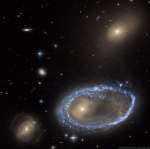 Ring Galaxy AM 0644 741
27.07.2021
The rim of the large blue galaxy at the right is an immense ring-like structure 150,000 light years in diameter composed of newly formed, extremely bright, massive stars. AM 0644-741 is known as a ring galaxy and was caused by an immense galaxy collision.
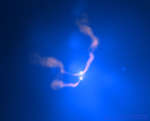 Two Black Holes Dancing in 3C 75
4.06.2022
What's happening at the center of active galaxy 3C 75? The two bright sources at the center of this composite x-ray (blue)/ radio (pink) image are co-orbiting supermassive black holes powering the giant radio source 3C 75.
|
January February March April May June July August September |
|||||||||||||||||||||||||||||||||||||||||||||||||