
|
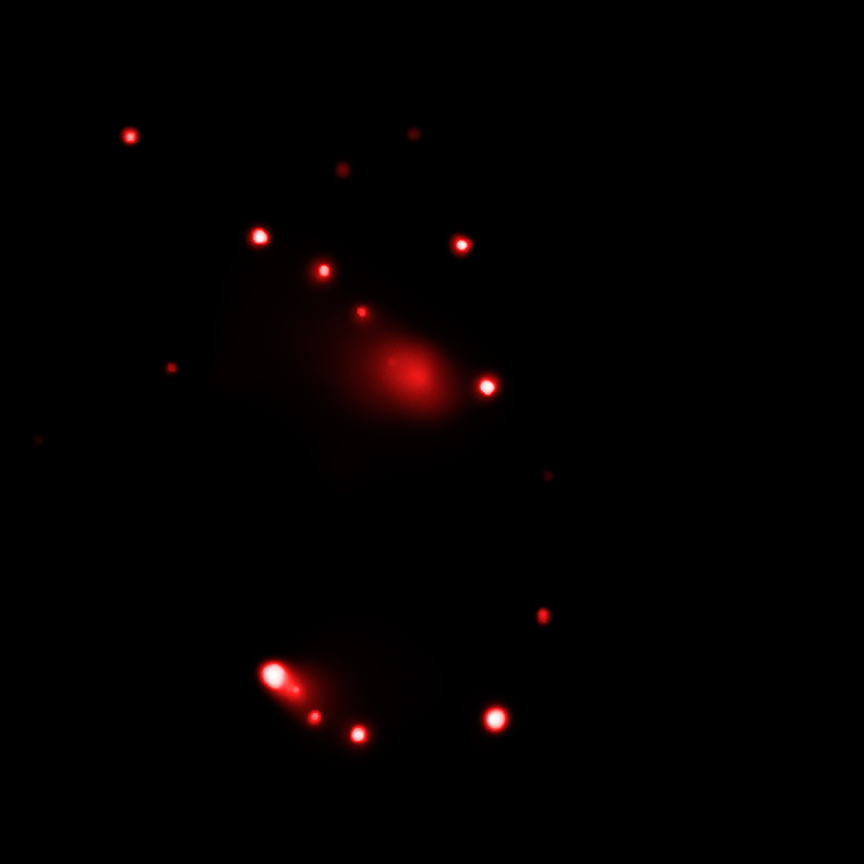
Explanation: Why does this galaxy have so many big black holes? No one is sure. What is sure is that NGC 922 is a ring galaxy created by the collision of a large and small galaxy about 300 million years ago. Like a rock thrown into a pond, the ancient collision sent ripples of high density gas out from the impact point near the center that partly condensed into stars. Pictured above is NGC 922 with its beautifully complex ring along the left side, as imaged recently by the Hubble Space Telescope. Observations of NGC 922 with the Chandra X-ray Observatory, however, show several glowing X-ray knots that are likely large black holes. The high number of massive black holes was somewhat surprising as the gas composition in NGC 922 -- rich in heavy elements -- should have discouraged almost anything so massive from forming. Research is sure to continue. NGC 922 spans about 75,000 light years, lies about 150 million light years away, and can be seen with a small telescope toward the constellation of the furnace (Fornax).

|
January February March April May June July August September October November December |
| |||||||||||||||||||||||||||||||||||||||||||||||||||||||
NASA Web Site Statements, Warnings, and Disclaimers
NASA Official: Jay Norris. Specific rights apply.
A service of: LHEA at NASA / GSFC
& Michigan Tech. U.
Based on Astronomy Picture
Of the Day
Publications with keywords: ring galaxy - spiral galaxy - colliding galaxies
Publications with words: ring galaxy - spiral galaxy - colliding galaxies
See also:
- APOD: 2026 September 16 Б Webb's View of M64
- APOD: 2026 September 11 Б M83: The Southern Pinwheel
- APOD: 2026 August 30 Б M74: A Grand Design Spiral
- NGC 300: A Cosmic Gemstone with Stars and Gas Clouds
- APOD: 2026 May 29 Б Messier 104
- APOD: 2026 April 5 Б NGC 3310: A Starburst Spiral Galaxy
- APOD: 2026 March 16 Б NGC 1566: The Spanish Dancer Galaxy