
|
You entered: orbit
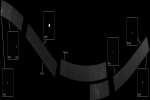 The Solar System from MESSENGER
23.02.2011
If you looked out from the center of the Solar System, what would you see? Nearly such a view was taken recently from the MESSENGER spacecraft currently orbiting the Sun from the distance of Mercury. The Sun's planets all appear as points of light, with the closest and largest planets appearing the brightest.
 Lunation
8.11.1999
Our Moon's appearance changes nightly. This slow-loading time-lapse sequence shows what our Moon looks like during a lunation, a complete lunar cycle. As the Moon orbits the Earth, the half illuminated by the Sun first becomes increasingly visible, then decreasingly visible. The Moon always keeps the same face toward the Earth.
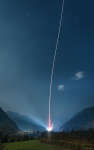 Rocket Launch between Mountains
4.12.2018
What's happening between those mountains? A rocket is being launched to space. Specifically, a Long March 3B Carrier Rocket was launched from Xichang Satellite Launch Center in Sichuan Province in China about two week ago.
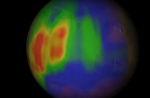 Mars Methane Mystery Deepens
22.04.2019
The methane mystery on Mars just got stranger. New results from ESA and Roscosmos' ExoMars Trace Gas Orbiter, has unexpectedly not detected methane in the atmosphere of Mars. This result follows the 2013 detection of methane by NASA's Curiosity rover, a result seemingly confirmed by ESA's orbiting Mars Express the next day.
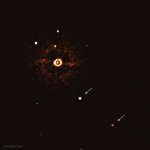 APOD: 2020 August 18 Б TYC 8998 760 1: Multiple Planets around a Sun Like Star
18.08.2020
Do other stars have planets like our Sun? Previous evidence shows that they do, coming mostly from slight shifts in the star's light created by the orbiting planets. Recently, however, and for the first time, a pair of planets has been directly imaged around a Sun-like star.
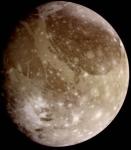 Ganymede: The Largest Moon in the Solar System
20.06.2000
If Ganymede orbited the Sun, it would be considered a planet. The reason is that Jupiter's moon Ganymede is not only the largest moon in the Solar System, it is larger than planets Mercury and Pluto.
 Asteroid 1998 WT24 Passes Near Earth
24.12.2001
Last week, an asteroid approached unusually close to the Earth. Passing well outside the orbit of our Moon, Asteroid 1998 WT24 posed no danger, but became bright enough to see with binoculars and to track with radar. Pictured above, the kilometer-sized asteroid was imaged crossing the sky on December 14, two days before closest approach.
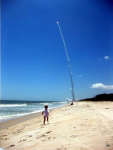 Chasing Juno
12.07.2016
Wait for me! In 2011, NASA's robotic mission Juno launched for Jupiter from Cape Canaveral, Florida, USA. Last week, Juno reached Jupiter and fired internal rockets to become only the second spacecraft to orbit our Solar System's largest planet.
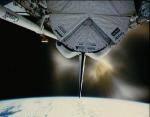 Shuttle Engine Blast
26.01.2002
The Space Shuttle Discovery's orbital maneuvering system (OMS) engine firing produced this dramatic flare as it cruised "upside down" in low Earth orbit. Discovery was named for a ship commanded by Captain James Cook RN, the 18th Century English astronomer and navigator.
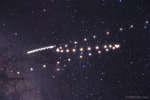 Retrograde Mars and Saturn
15.09.2016
Wandering Mars and Saturn have spent much of this year remarkably close in planet Earth's night sky. In a sequence of exposures spanning mid-December 2015 through the beginning of this week, this composited...
|
January February March April May June July August September |
|||||||||||||||||||||||||||||||||||||||||||||||||