
|
You entered: orbit
 APOD: 2025 July 20 Б Lunar Nearside
19.07.2025
About 1,300 images from the Lunar Reconnaissance Orbiter spacecraft's wide angle camera were used to compose this spectacular view of a familiar face - the lunar nearside. But why is there a lunar nearside? The Moon rotates on its axis and orbits the Earth at the same rate, about once every 28 days.
 Messenger Launch
14.08.2004
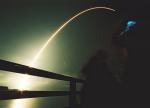
Streaking into the early morning sky on August 3rd, a Delta II rocket launches NASA's Messenger spacecraft on an interplanetary voyage to Mercury. Scheduled to become the first probe to orbit Mercury, Messenger will begin by looping through the inner Solar System in a series of close flybys of planet Earth and Venus.
 A Delta Rocket Launches
12.07.1999
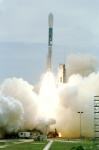
A Delta rocket is pictured launching NASA's FUSE satellite earlier this month. In use since 1960, Delta rockets have been launched successfully over 250 times. Scientific satellites placed into orbit by a Delta rocket include IUE, COBE, ROSAT, EUVE, WIND, and RXTE. Commercial launches include Iridium.
 Earth size Kepler 186f
19.04.2014
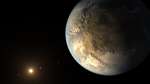
Planet Kepler-186f is the first known Earth-size planet to lie within the habitable zone of a star beyond the Sun. Discovered using data from the prolific planet-hunting Kepler spacecraft, the distant world orbits...
 Our Busy Solar System
24.07.2002
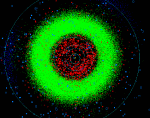
Our Solar System is a busy place. Although the major planets get the most press, a swarm of rocks, comets, and asteroids also exist. The above plot shows the placement of known inner Solar System objects on 2002 July 20. The light blue lines indicate the orbits of planets.
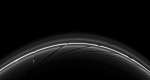 Prometheus Creating Saturn Ring Streamers
2.08.2010
What's causing those strange dark streaks in the rings of Saturn? Prometheus. Specifically, an orbital dance involving Saturn's moon Prometheus keeps creating unusual light and dark streamers in the F-Ring of Saturn. Now Prometheus orbits Saturn just inside the thin F-ring, but ventures into its inner edge about every 15 hours.
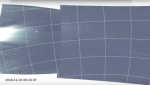 Looking Sideways from the Parker Solar Probe
8.12.2019
Everybody sees the Sun. Nobody's been there. Starting in 2018 though, NASA launched the robotic Parker Solar Probe (PSP) to investigate regions near to the Sun for the first time. The PSP's looping orbit brings it yet closer to the Sun each time around -- every few months.
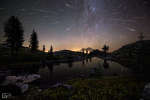 Perseid Meteors over Mount Shasta
7.08.2016
Where are all of these meteors coming from? In terms of direction on the sky, the pointed answer is the constellation of Perseus. That is why the meteor shower that peaks later this week is known as the Perseids -- the meteors all appear to came from a radiant toward Perseus.
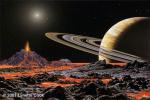 The 47 Ursae Majoris System
17.08.2001
Watching and waiting, astronomers have uncovered the presence of more than 70 planets orbiting stars other than the Sun. So far almost all these extrasolar planets have crazy elongated orbits, lie uncomfortably close to their parent stars, or are found in bizarre, inhospitable systems.
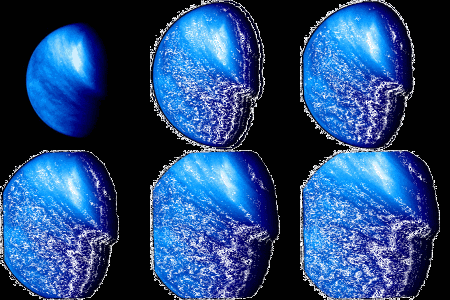 Venus Express Arrives at Venus
17.07.2006
Humanity now has a spacecraft orbiting Venus. The robotic Venus Express spacecraft launched by the European Space Agency in 2005 November arrived at Venus in 2006 April. Venus Express is now orbiting Earth's sister planet and returning pictures.
|
January February March April May June July August September |
|||||||||||||||||||||||||||||||||||||||||||||||||