
|
You entered: orbit
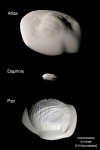 Atlas, Daphnis, and Pan
17.05.2019
Atlas, Daphnis, and Pan are small, inner, ring moons of Saturn. They are shown at the same scale in this montage of images by the Cassini spacecraft that made its grand final orbit of the ringed planet in September 2017. In fact, Daphnis was discovered in Cassini images from 2005.
 At the West Wall of Aristarchus Crater
17.02.2012
Aristarchus Plateau is anchored in the vast lava flows of the Moon's Oceanus Procellarum. At the plateau's southeastern edge lies the spectacular Aristarchus Crater, an impact crater 40 kilometers wide and 3 kilometers deep.
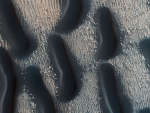 A Dark Dune Field in Proctor Crater on Mars
21.11.2010
Was this image taken with a telescope or a microscope? Perhaps this clue will help: if the dark forms were bacteria, they would each span over football field across. What is actually being seen are large sand dunes on the floor of Proctor Crater on Mars.
 A Full Moon at Perigee
7.11.2025
What is big, bright, and beautiful, can wear a cape made of clouds, and is at the closest point in its elliptical orbit around planet Earth? A full moon at perigee of course, captured here near moonset in predawn skies on November 5 from Kayseri, Turkiye.
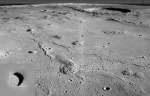 Marius Hills: Holes in the Moon
24.10.2017
Could humans live beneath the surface of the Moon? This intriguing possibility was bolstered in 2009 when Japan's Moon-orbiting SELENE spacecraft imaged a curious hole beneath the Marius Hills region on the Moon, possibly a skylight to an underground lava tube.
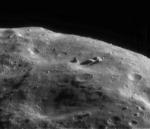 Eros Horizon View
25.05.2000
Since April 30, the robotic NEAR-Shoemaker spacecraft has been orbiting only 31 miles from asteroid Eros. Cruising over the asteroid's north and south poles at a leisurely 7 miles per hour, the spacecraft completes an orbit once every 1.2 earth days. This dramatic horizon view
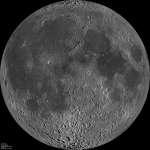 Lunar Nearside
2.03.2011
About 1,300 images from the Lunar Reconnaissance Orbiter spacecraft's wide angle camera were used to compose this spectacular view of a familiar face - the lunar nearside. But why is there a lunar nearside? The Moon rotates on its axis and orbits the Earth at the same rate, about once every 28 days.
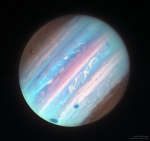 APOD: 2025 November 11 Б Jupiter in Ultraviolet from Hubble
10.11.2025
Jupiter looks a bit different in ultraviolet light. To better interpret Jupiter's cloud motions and to help NASA's robotic Juno spacecraft understand the planetary context of the small fields that it sees, the Hubble Space Telescope was being directed to regularly image the entire Jovian giant.
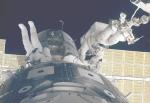 Assembling The International Space Station
9.12.1998
Batteries and solar panels were included with this version of the International Space Station (ISS) but some assembly is still required. On Saturday, December 5th, the STS-88 crew of the Space Shuttle Endeavor achieved the in orbit docking of the Zarya and Unity (foreground) ISS modules.
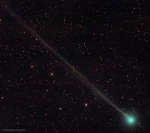 Comet 45P Returns
1.01.2017
An old comet has returned to the inner Solar System. Not only is Comet 45P/HondaMrkosPajduАkovА physically ancient, it was first discovered 13 orbits ago in 1948. Comet 45P spends most of its time out near the orbit of Jupiter and last neared the Sun in 2011.
|
January February March April May June July August September |
|||||||||||||||||||||||||||||||||||||||||||||||||