
|
You entered: orbit
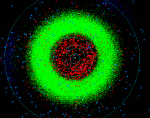 Our Busy Solar System
18.03.2006
Our Solar System is a busy place. Although the major planets get the most press, a swarm of rocks, comets, and asteroids also exist. The above plot shows the placement of known inner Solar System objects on 2002 July 20. The light blue lines indicate the orbits of planets.
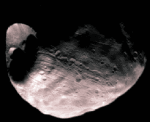 Phobos: Doomed Moon of Mars
31.05.1998
Phobos is doomed. Mars, the red planet named for the Roman god of war, has two tiny moons, Phobos and Deimos, whose names are derived from the Greek for Fear and Panic. These Martian...
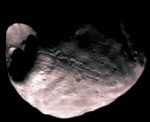 Phobos: Doomed Moon of Mars
1.10.1995
Mars, the red planet named for the Roman god of war, has two tiny moons, Phobos and Deimos, whose names are derived from the Greek for Fear and Panic. These Martian moons may well...
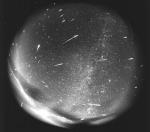 Leonids from Leo
15.11.2003
Is Leo leaking? Leo, the famous sky constellation visible on the left of the above all-sky photograph, appears to be the source of all the meteors seen in 1998's Leonids Meteor Shower. That...
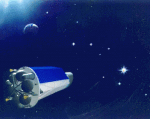 Searching For Solar Systems
14.11.1996
Observational astronomy has recently provided evidence of the existence of massive Jupiter-sized planets orbiting distant suns, protoplanetary disks of gas and dust surrounding newly formed stars, and planetary bodies orbiting exotic stellar corpses known as pulsars. Indeed, the formation of planets seems to be a broader and more varied phenomenon than previously imagined.
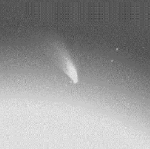 Comet Hyakutake Passes the Sun
16.05.1996
On May 1, Comet Hyakutake made its closest approach to the Sun. During this time it was not possible to view the comet with most astronomical instruments because of the brightness of the nearby Sun.
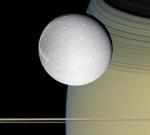 Ringside
21.10.2005
Orbiting in the plane of Saturn's rings, Dione and the other icy saturnian moons have a perpetual ringside view of the gorgeous gas giant planet. Of course, while passing through the ring plane the Cassini spacecraft also shares their stunning perspective.
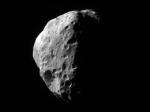 Epimetheus: A Small Moon of Saturn
24.08.2005
How did Epimetheus form? No one is yet sure. To help answer that question, this small moon has recently been imaged again in great detail by the robot spacecraft Cassini now orbiting Saturn. Epimetheus sometimes orbits Saturn in front of Janus, another small satellite, but sometimes behind.
 Orcus of the Outer Solar System
24.03.2009
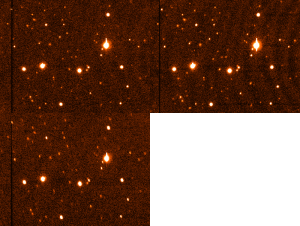
A newly discovered object in the outer Solar System moves like an anti-Pluto. 90482 Orcus was first discovered in 2004 and is slightly smaller than Pluto, although still one of the largest Kuiper belt objects known. Orcus may one day have the same IAU designation as Pluto: a dwarf planet.
 Geminids from Gemini
15.11.2021
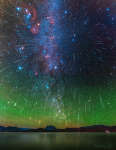
Where are all of these meteors coming from? In terms of direction on the sky, the pointed answer is the constellation of Gemini. That is why the major meteor shower in December is known as the Geminids -- because shower meteors all appear to come from a radiant toward Gemini.
|
January February March April May June July August September |
|||||||||||||||||||||||||||||||||||||||||||||||||