
|
You entered: orbit
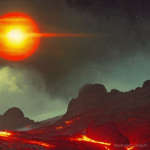 APOD: 2023 January 24 Б LHS 475 b: Earth Sized Exoplanet
24.01.2023
If you could stand on exoplanet LHS 475 b, what might you see? No one knows for sure but pictured here is an interesting guess made by an Earth-based artificial intelligence (AI) engine.
 Lunation
29.08.2004
Our Moon's appearance changes nightly. This time-lapse sequence shows what our Moon looks like during a lunation, a complete lunar cycle. As the Moon orbits the Earth, the half illuminated by the Sun first becomes increasingly visible, then decreasingly visible. The Moon always keeps the same face toward the Earth.
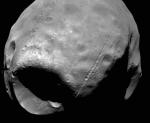 Phobos: Doomed Moon of Mars
6.04.2003
This moon is doomed. Mars, the red planet named for the Roman god of war, has two tiny moons, Phobos and Deimos, whose names are derived from the Greek for Fear and Panic. These...
 Lunation
10.08.2003
Our Moon's appearance changes nightly. This time-lapse sequence shows what our Moon looks like during a lunation, a complete lunar cycle. As the Moon orbits the Earth, the half illuminated by the Sun first becomes increasingly visible, then decreasingly visible. The Moon always keeps the same face toward the Earth.
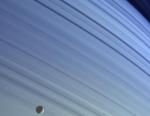 Blue Saturn
11.02.2005
Serene blue hues highlight this view of Saturn's northern hemisphere from the Cassini spacecraft. The image has been adjusted to approximate the natural blue color of visible sunlight scattered by the gas giant's upper atmosphere.
 Lunation
13.11.2005
Our Moon's appearance changes nightly. This time-lapse sequence shows what our Moon looks like during a lunation, a complete lunar cycle. As the Moon orbits the Earth, the half illuminated by the Sun first becomes increasingly visible, then decreasingly visible. The Moon always keeps the same face toward the Earth.
 Encke and the Tadpoles
27.10.2023
History's second known periodic comet is Comet Encke (2P/Encke). As it swings through the inner Solar System, Encke's orbit takes it from an aphelion, its greatest distance from the Sun, inside the orbit of Jupiter to a perihelion just inside the orbit of Mercury.
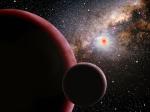 Super Earths May Circle Other Stars
20.03.2006
Are "super-Earths" common around other star systems? Quite possibly. Unexpected evidence for this came to light recently when a planet orbiting a distant star gravitationally magnified the light of an even more distant star.
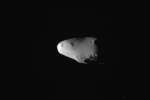 An Unusually Smooth Surface on Saturns Calypso
17.02.2010
Why is this moon of Saturn so smooth? This past weekend, humanity's Saturn-orbiting Cassini spacecraft passed as close to Saturn's small moon Calypso as it ever has, and imaged the small moon in unprecedented detail. Pictured above is an early return, raw, unprocessed image of the 20-km long irregularly shaped moon.
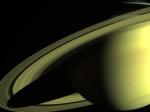 24 Million Kilometers to Saturn
31.05.2004
Next stop: Saturn. The Cassini-Huygens spacecraft is approaching Saturn and will fire its engines to break into orbit around the ringed giant on July 1. The robot spacecraft was launched in 1997 and rounded Jupiter in 2001.
|
January February March April May June July August September |
|||||||||||||||||||||||||||||||||||||||||||||||||