
|
You entered: orbit
 Pluto: The Frozen Planet
13.02.1999
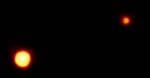
This portrait of Pluto and its companion Charon was taken by the Hubble Space Telescope in 1994. Pluto is usually the most distant planet from the Sun but because of its eccentric orbit Pluto crossed inside of Neptune's orbit in 1979.
 A Giant Planet for Beta Pic
3.07.2010
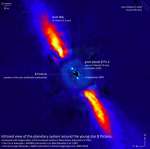
A mere 50 light-years away, young star Beta Pictoris became one of the most important stars in the sky in the early 1980s. Satellite and ground-based telescopic observations revealed the presence of a surrounding...
 The Kepler 90 Planetary System
18.12.2017
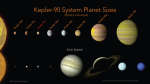
Do other stars have planetary systems like our own? Yes -- one such system is Kepler-90. Cataloged by the orbiting Kepler satellite, an eighth planet has now been discovered giving Kepler-90 the same number of known planets as our Solar System.
 Globular Cluster M22 from CFHT
27.06.2005
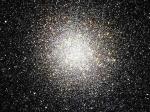
The globular cluster M22, pictured above, contains over 100,000 stars. These stars formed together and are gravitationally bound. Stars orbit the center of the cluster, and the cluster orbits the center of our Galaxy. So far, about 140 globular clusters are known to exist in a roughly spherical halo around the Galactic center.
 Aphelion Sunrise
5.07.2017
On July 3rd, planet Earth reached aphelion, the farthest point in its elliptical orbit around the Sun. Each year, this day of the most distant Sun happens to occur during winter in the southern hemisphere.
 Full Moonlight
3.01.2026
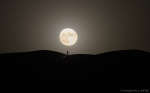
The Full Moon is the brightest lunar phase, and tonight you can stand in the light of the first Full Moon of 2026. In fact, the Moon's full phase occurs on January...
 Jupiters Moons Thebe, Amalthea, and Metis
8.05.2000
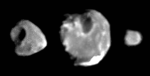
The robot spacecraft Galileo in orbit around Jupiter has recently photographed the inner moons of Jupiter in greater detail than ever before. These pictures of Thebe, Amalthea, and Metis are shown to scale, and reveal details as small as three kilometers across. Amalthea, by contrast, has a total length of about 200 kilometers.
 A Telescopic View of Erupting Comet Holmes
29.10.2007
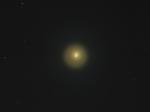
What's happened to Comet Holmes? A normally docile comet discovered over 100 years ago, Comet 17P/Holmes suddenly became nearly one million times brighter last week, possibly over just a few hours. In astronomical...
 Six Worlds for Kepler 11
3.02.2011
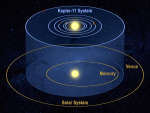
Six worlds orbit Kepler-11, a sunlike star 2,000 light-years distant in the constellation Cygnus. The new discovery, based on data from NASA's planet hunting Kepler spacecraft, makes the Kepler-11 system the fullest exoplanetary system known.
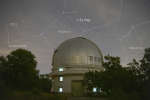 50 Light years to 51 Pegasi
9.10.2021
It's only 50 light-years to 51 Pegasi. That star's position is indicated in this snapshot from August, taken on a hazy night with mostly brighter stars visible above the dome at Observatoire de Haute-Provence in France.
|
January February March April May June July August September |
|||||||||||||||||||||||||||||||||||||||||||||||||