
|
You entered: orbit
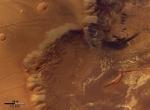 Melas Chasma
29.07.2004
Steep cliffs drop into the rugged terrain of Melas Chasma in this stunning view from the Mars Express spacecraft orbiting the Red Planet. At a scale of 16 meters per pixel, the image data...
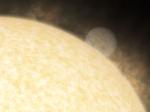 Light from a Extra Solar Planet
5.04.2005
Light emitted by a planet far beyond our Solar System has been identified for the first time. The planet, illustrated in the above drawing, had its light detected by comparing the brightness of only...
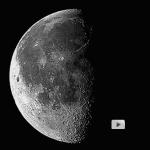 Lunation
2.09.2007
Our Moon's appearance changes nightly. This time-lapse sequence shows what our Moon looks like during a lunation, a complete lunar cycle. As the Moon orbits the Earth, the half illuminated by the Sun first becomes increasingly visible, then decreasingly visible. The Moon always keeps the same face toward the Earth.
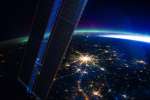 Yuri s Planet
12.04.2012
On another April 12th, in 1961, Soviet cosmonaut Yuri Alexseyevich Gagarin became the first human to see planet Earth from space. Commenting on his view from orbit he reported, "The sky is very dark; the Earth is bluish. Everything is seen very clearly". To celebrate, consider this recent image from the orbiting International Space Station.
 APOD: 2024 February 19 Б Looking Sideways from the Parker Solar Probe
19.02.2024
What's happening near the Sun? To help find out, NASA launched the robotic Parker Solar Probe (PSP) to investigate regions closer to the Sun than ever before. The PSP's looping orbit brings it nearer to the Sun each time around -- every few months.
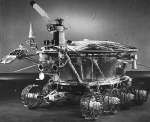 Lunokhod: Reflections on a Moon Robot
6.06.2010
It may look like some sort of cute alien robot, but it was created here on Earth, launched to the Moon in 1970, and now reflects laser light in a scientifically useful way. On November 17, 1970 the Soviet Luna 17 spacecraft landed the first roving remote-controlled robot on the Moon.
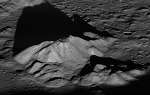 Sunrise at Tycho
6.07.2011
Tycho crater's central peak complex casts a long, dark shadow near local sunrise in this spectacular lunarscape. The dramatic oblique view was recorded on June 10 by the Lunar Reconnaissance Orbiter. Shown in amazing detail, boulder strewn slopes and jagged shadows appear in the highest resolution version at 1.5 meters per pixel.
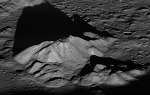 Sunrise at Tycho
4.01.2013
Tycho crater's central peak complex casts a long, dark shadow near local sunrise in this spectacular lunarscape. The dramatic oblique view was recorded on June 10, 2011 by the Lunar Reconnaissance Orbiter. Shown in amazing detail, boulder strewn slopes and jagged shadows appear in the highest resolution version at 1.5 meters per pixel.
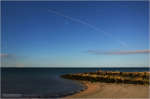 The Trail of a Minotaur
21.11.2013
Star trails arc above a moonlit beach and jetty in this serene sea and night skyscape. Captured on November 19, the single time exposure looks south down the Atlantic coast from Cape Cod, Massachusetts, USA.
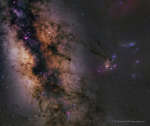 Saturn in the Milky Way
10.06.2017
Saturn is near opposition in planet Earth's sky. Rising at sunset and shining brightly throughout the night, it also lies near a line-of-sight to crowded starfields, nebulae, and obscuring dust clouds along the Milky Way.
|
January February March April May June July August September |
|||||||||||||||||||||||||||||||||||||||||||||||||