
|
You entered: orbit
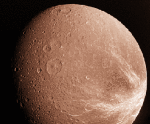 Saturn's Moon Dione
9.10.1995
Dione, one of Saturn's larger moons, is remarkable for its bright surface streaks. These streaks run across some of Dione's many craters, which indicate that the process which created the streaks occurred later than the process which created the craters.
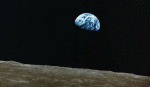 Earth Rise
25.12.1995
During the 1968 Christmas season Frank Borman, James Lovell, and William Anders flew the Apollo 8 command module From the Earth to the Moon and back (launched Dec. 21, achieved 10 lunar orbits, landed Dec. 27).
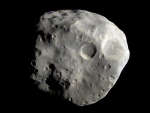 Saturns Moon Epimetheus from the Cassini Spacecraft
11.02.2008
How did Epimetheus form? No one is yet sure. To help answer that question, this small moon has recently been imaged again in great detail by the robot spacecraft Cassini now orbiting Saturn. Epimetheus sometimes orbits Saturn in front of Janus, another small satellite, but sometimes behind.
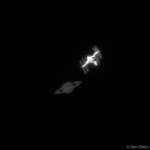 Saturn and ISS
9.07.2022
Soaring high in skies around planet Earth, bright planet Saturn was a star of June's morning planet parade. But very briefly on June 24 it posed with a bright object in low Earth orbit, the International Space Station.
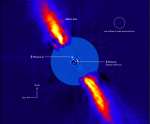 Probably a Planet for Beta Pic
28.11.2008
A mere 50 light-years away, young star Beta Pictoris became one of the most important stars in the sky in the early 1980s. Satellite and ground-based telescopic observations revealed the presence of a surrounding...
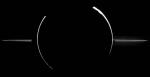 Jupiters Rings Revealed
16.09.1998
Why does Jupiter have rings? Jupiter's rings were discovered in 1979 by the passing Voyager 1 spacecraft, but their origin has always been a mystery. Recent data from the Galileo spacecraft currently orbiting Jupiter now confirms that these rings were created by meteoroid impacts on small nearby moons.
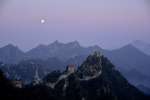 The Great Wall by Moonlight
12.03.2015
Last Friday, an almost Full Moon rose as the Sun set, over this mountainous landscape north of Beijing, China. Also near apogee, the farthest point in its elliptical orbit around planet Earth, it was this year's smallest and faintest Full Moon.
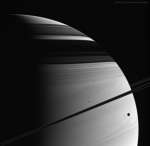 Moons, Rings, Shadows, Clouds: Saturn (Cassini)
2.04.2018
While cruising around Saturn, be on the lookout for picturesque juxtapositions of moons, rings, and shadows. One quite picturesque arrangement occurred in 2005 and was captured by the then Saturn-orbiting Cassini spacecraft. In the featured image, moons Tethys and Mimas are visible on either side of Saturn's thin rings, which are seen nearly edge-on.
 Lunation
18.02.2001
Our Moon's appearance changes nightly. This slow-loading time-lapse sequence shows what our Moon looks like during a lunation, a complete lunar cycle. As the Moon orbits the Earth, the half illuminated by the Sun first becomes increasingly visible, then decreasingly visible. The Moon always keeps the same face toward the Earth.
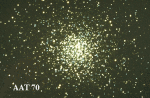 Globular Cluster M5
19.10.1995
The globular cluster M5, pictured above, contains roughly 100,000 stars. These stars formed together and are gravitationally bound. Stars orbit the center of the cluster, and the cluster orbits the center of our Galaxy. So far, about 160 globular clusters are known to exist in a roughly spherical halo around the Galactic center.
|
January February March April May June July August September |
|||||||||||||||||||||||||||||||||||||||||||||||||