
|
You entered: orbit
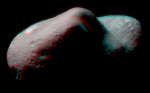 Stereo Eros
12.02.2021
Get out your red/blue glasses and float next to asteroid 433 Eros. Orbiting the Sun once every 1.8 years, the near-Earth asteroid is named for the Greek god of love. Still, its shape more closely resembles a lumpy potato than a heart.
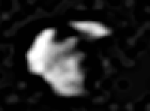 Dione's Lagrange Moon Helene
9.10.1995
Saturn's moon Helene is very unusual in that it circles Saturn near the orbit of a bigger moon: Dione. Helene is situated in what is called a "Lagrange point" of Dione - a place of stability created by Dione's gravity.
 Mars: A Canyon's Edge
18.03.1998
High resolution Mars Global Surveyor images were combined with Viking Orbiter color data to produce this stunning, detailed view of a Martian canyon's edge. The area pictured is about 6 miles wide and represents a tiny part of the northern edge of the canyon Valles Marineris, whose total length is about 2,500 miles.
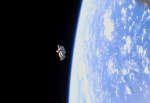 SuitSat1: A Spacesuit Floats Free
27.04.2014
A spacesuit floated away from the International Space Station eight years ago, but no investigation was conducted. Everyone knew that it pushed by the space station crew. Dubbed Suitsat-1, the unneeded Russian Orlan spacesuit filled mostly with old clothes was fitted with a faint radio transmitter and released to orbit the Earth.
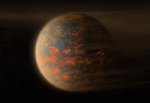 Cancri 55 e: Climate Patterns on a Lava World
4.04.2016
Why might you want to visit super-earth Cancri 55 e? Its extremely hot climate would be a deterrent, as mornings on this world might bring fresh lava flows. Discovered in 2004, the planet Cancri 55 e has twice the diameter of our Earth and about 10 times Earth's mass.
 Jupiter and Saturn Pas de Deux
19.12.2001
Viewed from Earth, the solar system's planets do a cosmic dance that is hard to appreciate on any single night. But consider this well planned animated sequence combining 23 pictures taken at approximately 2 week intervals from June 2000 through May 2001.
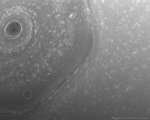 Over Saturns Turbulent North Pole
11.12.2016
The Cassini spacecraft's Grand Finale at Saturn has begun. The Grand Finale will allow Cassini to explore Saturn and some of Saturn's moons and rings in unprecedented detail. The first phase started...
 COBE Dipole: Speeding Through the Universe
8.02.2003
Our Earth is not at rest. The Earth moves around the Sun. The Sun orbits the center of the Milky Way Galaxy. The Milky Way Galaxy orbits in the Local Group of Galaxies. The Local Group falls toward the Virgo Cluster of Galaxies.
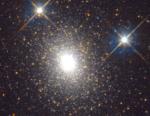 A Giant Globular Cluster in M31
17.10.1998
This cluster of stars, known as G1, is the brightest globular cluster in the whole Local Group of galaxies. Also called Mayall II, it orbits the center of the largest nearby galaxy: M31. G1 contains over 300,000 stars and is almost as old as the entire universe.
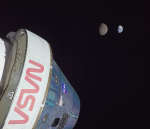 Artemis 1: Flight Day 13
30.11.2022
On flight day 13 (November 28) of the Artemis 1 mission the Orion spacecraft reached its maximum distance from Earth. In fact, over 430,000 kilometers from Earth its distant retrograde orbit also put Orion nearly 70,000 kilometers from the Moon.
|
January February March April May June July August September |
|||||||||||||||||||||||||||||||||||||||||||||||||