
|
You entered: orbit
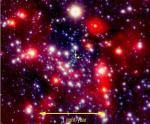 At the Center of the Milk Way
23.10.2005
At the center of our Milky Way Galaxy lies a black hole with over 2 million times the mass of the Sun. Once a controversial claim, this astounding conclusion is now virtually inescapable and based on observations of stars orbiting very near the galactic center.
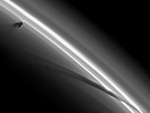 Prometheus Creating Saturn Ring Streamers
27.04.2009
What's causing those strange dark streaks in the rings of Saturn? Prometheus. Specifically, an orbital dance involving Saturn's moon Prometheus keeps creating unusual light and dark streamers in the F-Ring of Saturn. Now Prometheus orbits Saturn just inside the thin F-ring, but ventures into its inner edge about every 15 hours.
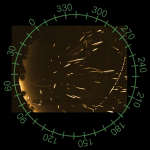 Perseids from Perseus
17.08.2009
Where are all of these meteors coming from? In terms of direction on the sky, the pointed answer is the constellation of Perseus. That is why the last week's meteor shower was known as the Perseids -- the meteors all appear to come from a radiant toward Perseus.
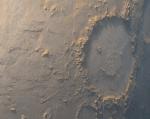 Happy Face Crater on Mars
14.03.1999
Even Mars can put on a happy face. The Martian crater Galle has internal markings reminiscent of a smiley face symbol. Such markings were originally discovered in the late 1970s in pictures taken by the Viking Orbiter. A large meteor impacted the Martian surface to form the crater.
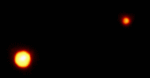 Pluto: The Frozen Planet
27.12.1997
The Hubble Space Telescope imaged Pluto and its moon Charon in 1994. Pluto is usually the most distant planet from the Sun but because of its elliptic orbit Pluto crossed inside of Neptune's orbit in 1979 and will cross back out again in 1999.
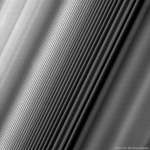 Density Waves in Saturns Rings from Cassini
7.08.2017
What causes the patterns in Saturn's rings? The Cassini spacecraft, soon ending its 13 years orbiting Saturn, has sent back another spectacular image of Saturn's immense ring system in unprecedented detail. The physical cause for some of Saturn's ring structures is not always understood.
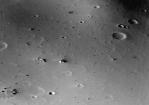 18 Miles From Deimos
19.09.1998
Diminutive Deimos is the smallest of the two tiny Moons of Mars. Potato-shaped and barely 6 miles wide this asteroid-like body was visited by the Viking 2 orbiter in 1977. This image was made when the spacecraft approached to within 18 miles of Deimos' surface.
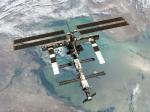 The International Space Station from Above
16.05.2006
The International Space Station (ISS) is the largest human-made object ever to orbit the Earth. Last August, the station was visited and resupplied by space shuttle Discovery. The ISS is currently operated by the Expedition 13 crew, consisting a Russian and an American astronaut.
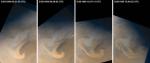 Mars Weather Watch
16.08.1999
Mars may be a cold, dry planet but its weather is dynamic. On June 30, wide angle cameras on board the Mars Global Surveyor (MGS) spacecraft watched the development of this large scale storm system above Mars' north polar area.
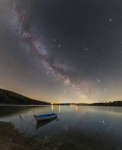 Lyrid Meteors from the Constellation Lyra
11.05.2020
Where are all of these meteors coming from? In terms of direction on the sky, the pointed answer is the constellation of Small Harp (Lyra). That is why the famous meteor shower that peaks every April is known as the Lyrids -- the meteors all appear to came from a radiant toward Lyra.
|
January February March April May June July August September |
|||||||||||||||||||||||||||||||||||||||||||||||||