
|
You entered: orbit
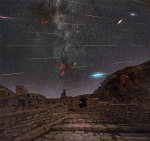 A Meteor Wind over Tunisia
16.08.2022
Does the Earth ever pass through a wind of meteors? Yes, and they are frequently visible as meteor showers. Almost all meteors are sand-sized debris that escaped from a Sun-orbiting comet or asteroid, debris that continues in an elongated orbit around the Sun.
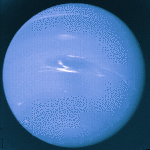 Neptune: Big Blue Giant
21.02.1998
This picture was taken by the Voyager 2 spacecraft in 1989 - the only spacecraft ever to visit Neptune. Neptune will be the farthest planet from the Sun until 1999, when the elliptical orbit of Pluto will cause it to once again resume this status.
 Mars: Cydonia Close Up
16.04.1998
The Mars Global Surveyor spacecraft has returned another close-up of the Cydonia region on Mars. Orbiting over clear Martian skies at a range of about 200 miles, the Mars Orbiter Camera looked down...
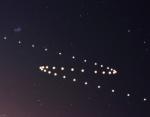 Z is for Mars
22.04.2006
This composite of images spaced about a week apart - from late July 2005 (bottom right) through February 2006 (top left) - traces the retrograde motion of ruddy-colored Mars through planet Earth's night sky. On November 7th, 2005 the Red Planet was opposite the Sun in Earth's sky (at opposition).
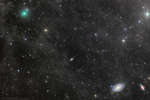 Comet ATLAS and the Mighty Galaxies
21.03.2020
Comet ATLAS C/2019 Y4 was discovered by the NASA funded Asteroid Terrestrial-impact Last Alert System, the last comet discovery reported in 2019. Now growing brighter in northern night skies, the comet's pretty greenish...
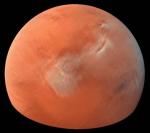 Clouds Over Tharsis on Mars
17.03.1998
When and where do clouds form on Mars? The Mars Global Surveyor spacecraft currently orbiting Mars is finding out. Photographs released last week showed clouds forming above Tharsis, a huge bulge on Mars about 4000 kilometers across and 7 kilometers high containing several large volcanoes.
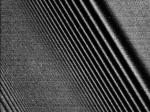 Cassini Images Density Waves in Saturns Rings
5.07.2004
What causes the patterns in Saturn's rings? The Cassini spacecraft just entering orbit around Saturn has started sending back spectacular images of Saturn's immense ring system in unprecedented detail. The physical cause for many of newly resolved ring structures is not always understood.
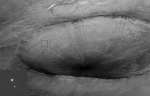 Descent of the Phoenix
30.05.2008
In this sweeping view, the 10 kilometer-wide crater Heimdall lies on the north polar plains of Mars. But the bright spot highlighted in the inset is the Phoenix lander parachuting toward the surface. The amazing picture was captured on May 25th by the HiRISE camera onboard the Mars Reconnaissance Orbiter.
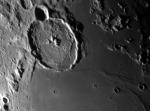 Lunar Close Up
12.02.1999
Late last month, NASA's Lunar Prospector spacecraft moved in for a closer look at the Moon. Now entering an extended mission phase, controllers have reduced the altitude of this polar lunar orbiter from 100 kilometers to about 30 kilometers (18 miles).
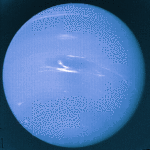 Neptune: Big Blue Giant
17.08.1995
This picture was taken by the Voyager 2 spacecraft in 1986 - the only spacecraft ever to visit Neptune. Neptune will be the farthest planet from the Sun until 1999, when the elliptical orbit of Pluto will cause it to once again resume this status.
|
January February March April May June July August September |
|||||||||||||||||||||||||||||||||||||||||||||||||