
|
You entered: orbit
 A Planet For Gliese 876
26.06.1998
Centered in this unremarkable, 1/4 degree wide patch of sky in the constellation Aquarius is the star Gliese 876. Gliese 876 is smaller than the Sun, only about 1/3 as massive, and too faint to be seen without a telescope. But it is known to be one of the nearest stars, only 15 light-years distant.
 APOD: 2025 October 19 Б Comet Churyumov Gerasimenko Creates Its Tails
19.10.2025
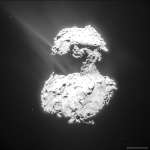
Where do comet tails come from? There are usually no obvious places on the nuclei of comets from which the jets that create comet tails emanate. One of the best images of emerging jets...
 APOD: 2004 August 27- The Sedna Scenario
27.08.2004
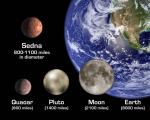
The discovery of Sedna (aka 2003 VB12), the most distant known object orbiting the Sun, presents a mystery. Pluto's orbit averages about 40 AU in radius, where an AU (Astronomical Unit) is the Earth-Sun distance.
 Perihelion Sun
11.01.1999
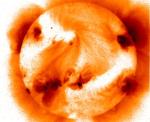
The Earth's orbit is not a perfect, sun-centered circle. At aphelion, the most distant point in Earth's orbit, the Sun is 150 million kilometers away and at perihelion, the closest point, Earth approaches the Sun to within about 147 million kilometers. While aphelion occurs in July, perihelion for planet Earth comes in January.
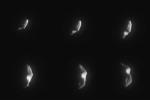 NEAR to Asteroid Eros
5.02.2000
On December 23, 1998 the Near Earth Asteroid Rendezvous (NEAR) spacecraft flew by asteroid 433 Eros. The robotic spacecraft was intended to brake and orbit Eros, but an unexpected shutdown of its main engine caused this plan to be aborted.
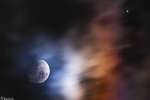 APOD: 2020 September 2 Б Jupiter and the Moons
2.09.2020
How many moons do you see? Many people would say one, referring to the Earth's Moon, prominent on the lower left. But take a closer look at the object on the upper right.
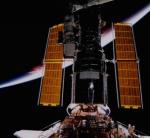 Hubble Holiday
24.12.1999
How would you like to spend your holiday in low earth orbit? That's what the crew of the space shuttle Discovery is doing as they deliver six new gyros and a faster main computer to the orbiting Hubble Space Telescope.
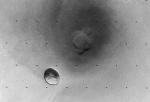 Phobos Over Mars
29.11.2003
Hurtling through space a mere 3,000 miles above the Martian surface, the diminutive moon Phobos (below and left of center) was imaged against the backdrop of a large shield volcano by the Viking 2 Orbiter in 1977.
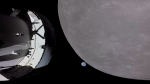 Earthset from Orion
24.01.2026
Eight billion people are about to disappear in this snapshot from space taken on 2022 November 21. On the sixth day of the Artemis I mission, their home world is setting behind the Moon's bright edge as viewed by an external camera on the outbound Orion spacecraft.
 Leonids from Leo
17.11.2002
Is Leo leaking? Leo, the famous sky constellation visible on the left of the above all-sky photograph, appears to be the source of all the meteors seen in last year's Leonids Meteor Shower.
|
January February March April May June July August September |
|||||||||||||||||||||||||||||||||||||||||||||||||