
|
You entered: orbit
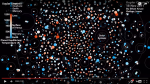 Kepler Orrery IV
5.12.2015
The exoplanet hunting Kepler mission's total for candidate and confirmed multiple planet systems stands at 1,705 worlds in orbit around 685 distant stars. Put all of those exoplanet orbits on the same scale and follow their relative orbital motions to get Kepler Orrery IV.
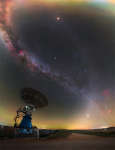 APOD: 2025 November 3 Б A Double Helix Lunar Eclipse
3.11.2025
The image was timed to capture a total lunar eclipse -- but it came with quite a twist. First, the eclipse: the fully Earth-shadowed Moon is visible as the orange orb near the top.
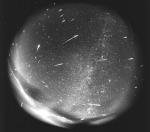 Leonids from Leo
8.12.1998
Is Leo leaking? Leo, the famous sky constellation visible on the left of the above all-sky photograph, appears to be the source of all the meteors seen in this year's Leonids Meteor Shower.
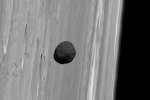 Martian Moon Phobos from Mars Express
1.12.2010
Why is Phobos so dark? Phobos, the largest and innermost of two Martian moons, is the darkest moon in the entire Solar System. Its unusual orbit and color indicate that it may be a captured asteroid composed of a mixture of ice and dark rock.
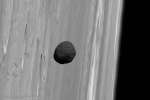 Martian Moon Phobos from Mars Express
8.11.2020
Why is Phobos so dark? Phobos, the largest and innermost of two Martian moons, is the darkest moon in the entire Solar System. Its unusual orbit and color indicate that it may be a captured asteroid composed of a mixture of ice and dark rock.
 Chandra X Ray Telescope
27.07.1999
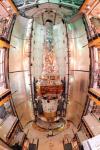
Wrapped in protective blankets and mounted atop an Inertial Upper Stage (IUS) rocket, the Chandra X-ray Telescope is seen in this wide-angle view before launch snuggled into the space shuttle Columbia's payload bay.
 Phobos from Mars Express
17.03.2010
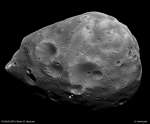
Why is this small object orbiting Mars? The origin of Phobos, the larger of the two moons orbiting Mars, remains unknown. Phobos and Deimos appear very similar to C-type asteroids, yet gravitationally capturing such asteroids, circularizing their orbits, and dragging them into Mars' equatorial plane seems unlikely.
 Phobos Over Mars
13.03.1999
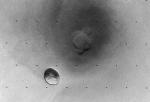
Hurtling through space a mere 3,000 miles above the Martian surface, the diminutive moon Phobos (below and left of center) was imaged against the backdrop of a large shield volcano by the Viking 2 Orbiter in 1977.
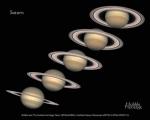 The Seasons of Saturn
2.07.2001
Soon it will be winter in Saturn's northern hemisphere. Since Saturn is tilted in its orbit around the Sun, it has seasons just like the Earth. When a hemisphere is tilted so that the Sun passes more directly overhead, summer occurs. Half an orbit later -- about 15 (Earth) years for Saturn -- winter occurs.
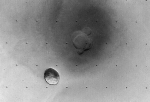 Phobos Over Mars
15.10.1996
Hurtling through space a mere 3,000 miles above the Martian surface, the diminutive moon Phobos (below and left of center) was imaged against the backdrop of a large shield volcano by the Viking 2 Orbiter in 1977.
|
January February March April May June July August September |
|||||||||||||||||||||||||||||||||||||||||||||||||