
|
You entered: orbit
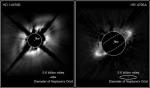 Possible Planets And Infrared Dust
20.01.1999
These near-infrared Hubble images of dust surrounding young stars offer the latest tantalizing evidence for planets beyond our Solar System. At left, the dark gap seen in the dust disk is reminiscent of a similar large gap in Saturn's rings believed to be sculpted by orbiting moons.
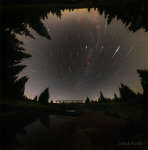 APOD: 2026 August 18 Б Perseids from Perseus
18.08.2026
This was a good year for the Perseids meteor shower. A key reason was the Moon was absent from lighting up Earth's night sky so that more meteors were visible than usual. Where was the Moon? It was busy visiting the Sun.
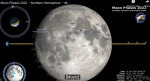 Moon Phases 2022
1.02.2022
What will the Moon phase be on your birthday this year? It is hard to predict because the Moon's appearance changes nightly. As the Moon orbits the Earth, the half illuminated by the Sun first becomes increasingly visible, then decreasingly visible.
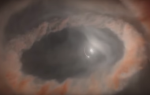 GW Orionis: A Star System with Titled Rings
29.09.2020
Triple star system GW Orionis appears to demonstrate that planets can form and orbit in multiple planes. In contrast, all the planets and moons in our Solar System orbit in nearly the same plane. The picturesque system has three prominent stars, a warped disk, and inner tilted rings of gas and grit.
 Kepler Discovers How Planets Move
6.06.1999
Johannes Kepler used simple mathematics to describe how planets move. Kepler was an assistant to the most accurate astronomical observer of the time, Tycho Brahe. Kepler was able to use Brahe's data...
 Kepler Discovers How Planets Move
14.01.2001
Johannes Kepler used simple mathematics to describe how planets move. Kepler was an assistant to the most accurate astronomical observer of the time, Tycho Brahe. Kepler was able to use Brahe's data...
 Slightly Beneath Saturns Ring Plane
5.04.2006
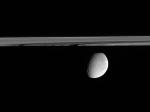
When orbiting Saturn, be sure to watch for breathtaking superpositions of moons, rings, and shadows. One such picturesque vista was visible recently to the robot Cassini spacecraft now orbiting Saturn. In late February, Cassini captured a Rhea, the second largest moon of Saturn, while looking up from slightly beneath Saturn's expansive ring plane.
 Discovery in Motion
8.07.2006
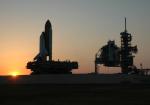
On July 4th, the space shuttle orbiter Discovery rocketed into space on mission STS-121. Now docked with the International Space Station, Discovery orbits planet Earth at about 27 thousand kilometers per hour.
 The Four Suns of HD 98800
30.07.2007
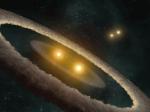
How would it look to have four suns in the sky? Planets of the HD 98800 system, if they exist, would experience such a view. HD 98800 is a multiple star system about 150 light years from Earth -- right in our section of the Milky Way Galaxy.
 A Star Cluster in Motion
30.07.2002
Star clusters are a swarm of complex motions. The stars that compose globular clusters and many open clusters all orbit the cluster center, occasionally interacting, gravitationally, with a close-passing star. The orbits of stars around the cluster are typically not as circular as the orbits of planets in our solar system.
|
January February March April May June July August September |
|||||||||||||||||||||||||||||||||||||||||||||||||