
|
You entered: orbit
 Gliese 581 and the Habitable Zone
26.04.2007
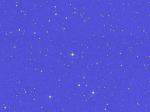
The faint, unremarkable star centered in this skyview is Gliese 581, a mere 20 light-years away toward the constellation Libra. But astronomers are now reporting the discovery of a remarkable system of three planets orbiting Gliese 581, including the most earth-like planet found beyond our solar system.
APOD: 2025 October 4 Б The Rotating Moon
4.10.2025
No one on Earth sees the Moon rotate like this. That's because the Moon is tidally locked in synchronous rotation, showing only one side to denizens of our fair planet. Still, given modern...
 The Decade that Defined Star System
29.12.1999
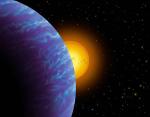
As the 1990s began, the only planetary star system known was our own Solar System. The first extra-solar star system was discovered orbiting a pulsar in 1991. Slight changes in the precise arrival times of the pulses from the central small dense neutron star gave evidence of orbiting planets.
 Restored: First Image of the Earth from the Moon
18.11.2008
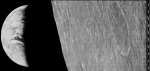
Pictured above is the first image ever taken of the Earth from the Moon. The image was taken in 1966 by Lunar Orbiter 1 and heralded by then-journalists as the Image of the Century. It was taken about two years before the Apollo 8 crew snapped its more famous color cousin.
 55 Cancri: Familiar Planet Discovered
14.06.2002
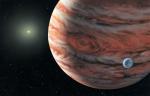
Is our Solar System unique? The discovery of a Jupiter-like planet in a Jupiter-like orbit around nearby Sun-like star 55 Cancri, announced yesterday, gives a new indication that planetary systems similar to our Solar System likely exist elsewhere. The planet, discovered by G.
 The Moons of Earth
30.04.2005
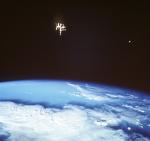
While orbiting the planet during their June 1998 mission, the crew of the Space Shuttle Discovery photographed this view of two moons of Earth. Thick storm clouds are visible in the lovely blue planet...
 Kepler 78b: Earth Sized Planet Discovered
5.11.2013
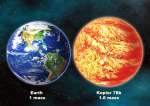
Even though Kepler-78b is only slightly larger than the Earth, it should not exist. Its size is extraordinary only in the sense that it is the most similar in size to the Earth of any exoplanet yet directly discovered.
 HR 8799: Discovery of a Multi planet Star System
17.11.2008
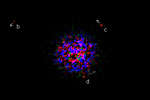
How common are planetary systems like our own Solar System? In the twelve years previous to 2008, over 300 candidate planetary systems have been found orbiting nearby stars. None, however, were directly imaged, few showed evidence for multiple planets, and many had a Jupiter-sized planet orbiting inside the orbit of Mercury.
 The Night Shift
17.12.1998
For the orbiting International Space Station (ISS), the sun sets every 90 minutes. But working through the night, spacewalking astronauts can rely on artificial lighting. Here, the eerie glow of work-lights illuminate Space Shuttle Endeavor astronaut Jerry Ross during a night on his
 Von Braun's Wheel
28.03.1998
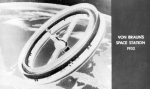
Orbiting 1,075 miles above the Earth, a 250 foot wide, inflated, reinforced nylon "wheel" was conceived in the early 1950s to function as a navigational aid, meteorological station, military platform, and way station for space exploration by rocket pioneer Wernher von Braun.
|
January February March April May June July August September |
|||||||||||||||||||||||||||||||||||||||||||||||||