
|
You entered: orbit
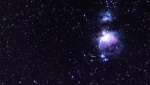 Geostationary Highway through Orion
16.01.2017
Put a satellite in a circular orbit about 42,000 kilometers from the center of the Earth and it will orbit once in 24 hours. Because that matches Earth's rotation period, it is known as a geosynchronous orbit.
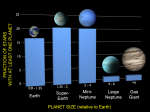 Ten Billion Earths
12.01.2013
How common are Earth-sized planets? Quite common, according to extrapolations from new data taken by NASA's orbiting Kepler spacecraft. Current computer models are indicating that at least one in ten stars are orbited by an Earth-sized planet, making our Milky Way Galaxy the home to over ten billion Earths.
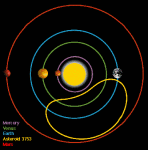 Asteroid 3753: Earth's Curious Companion
18.06.1997
Earth is not alone. It orbits the Sun with a small companion: Asteroid 3753. First discovered in 1986 and designated 1986 OT, this five kilometer rock was recently found to orbit the Sun while executing a strange dance with the Earth. A portion of the asteroid's complex orbit is shown above.
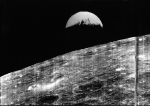 The Earth Also Rises
13.10.1996
The Lunar Orbiter 1 spacecraft was launched in 1966 to map the lunar surface in preparation for the Apollo moon landings. NASA's plucky robotic explorer performed its job well and pioneered this classic view of the Earth poised above the lunar horizon.
 Eris: More Massive than Pluto
19.06.2007
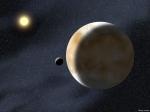
Eris, a dwarf planet currently orbiting the Sun at about twice Pluto's distance, has been measured to have about 27 percent more mass than Pluto. The mass was calculated by timing the orbit of Eris' moon Dysnomia.
 Earth, Clouds, Sky, Comet
3.04.1997
Does a comet's dust tail always orbit behind it? Since comets rotate, they shed gas and dust in all directions equally. Small ice and dust particles expelled by the comet, however, are literally pushed around by sunlight. The smaller the particle, the greater the effect.
 Ultraviolet Venus
7.05.1997
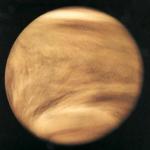
The forecast for Venus is cloudy, cloudy, cloudy. Although similar to the Earth in size and mass, Venus' slightly closer orbit to the Sun create for it a much thicker atmosphere and a much hotter surface. The thick atmosphere was photographed above in ultraviolet light in 1979 by the Pioneer Venus Orbiter.
 APOD: 2024 February 26 Б Martian Moon Eclipses Martian Moon
26.02.2024
What if there were two moons in the sky -- and they eclipsed each other? This happens on Mars. The featured video shows a version of this unusual eclipse from space. Pictured are the two moons of Mars: the larger Phobos, which orbits closer to the red planet, and the smaller Deimos, which orbits further out.
 Mercury: A Cratered Inferno
19.08.2001
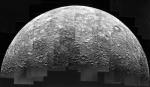
Mercury's surface looks similar to our Moon's. Each is heavily cratered and made of rock. Mercury's diameter is about 4800 km, while the Moon's is slightly less at about 3500 km (compared with about 12,700 km for the Earth). But Mercury is unique in many ways.
 Nearby Star Epsilon Eridani Has a Planet
7.08.2000
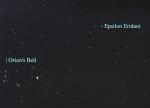
A planet has been found orbiting a Sun-like star only 10 light-years away. No direct picture of the planet was taken - the planet was discovered by the gravitational wobble it created on its parent star, Epsilon Eridani. The discovery marks the closest Sun-like star yet found to house an extra-solar planet.
|
January February March April May June July August September |
|||||||||||||||||||||||||||||||||||||||||||||||||