
|
You entered: orbit
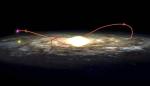 Where a Black Hole Roams
21.09.2001
Black hole candidate XTE J1118+480 is known to roam the halo of our Milky Way Galaxy. This exotic system - thought to be a stellar mass black hole consuming matter from a companion star - was discovered only last year as a flaring celestial x-ray source.
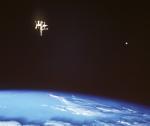 The Moons Of Earth
13.08.1998
While orbiting the planet during their June 1998 mission, the crew of the Space Shuttle Discovery photographed this view of two moons of Earth. Thick storm clouds are visible in the lovely blue planet...
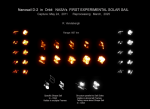 NanoSail D2
2.01.2026
In 2011, on January 20, NASA's NanoSail-D2 unfurled a very thin and very reflective 10 square meter sail becoming the first solar sail spacecraft in low Earth orbit. Often considered the stuff...
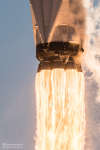 TESS Launch Close Up
21.04.2018
NASA's Transiting Exoplanet Survey Satellite (TESS) began its search for planets orbiting other stars by leaving planet Earth on April 18. The exoplanet hunter rode to orbit on top of a Falcon 9 rocket.
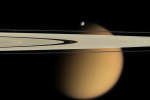 Titan Beyond the Rings
5.05.2009
When orbiting Saturn, be sure to watch for breathtaking superpositions of moons and rings. One such picturesque vista was visible recently to the robot Cassini spacecraft now orbiting Saturn. In 2006 April, Cassini captured Saturn's A and F rings stretching in front of cloud-shrouded Titan.
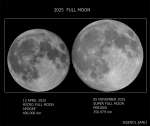 APOD: 2025 November 10 Б Micro Moon vs Super Moon
10.11.2025
What was so super about Wednesday's supermoon? Last week, a full moon occurred that appeared slightly larger and brighter than usual. The reason is that the Moon's fully illuminated phase occurred within a short time from perigee - when the Moon was its closest to the Earth in its elliptical orbit.
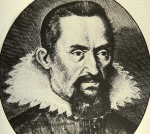 Kepler Discovers How Planets Move
13.09.1997
Johannes Kepler used simple mathematics to describe how planets move. Kepler was an assistant to the most accurate astronomical observer of the time, Tycho Brahe. Kepler was able to use Brahe's data...
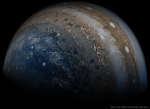 Beneath Jupiter
29.05.2017
Jupiter is stranger than we knew. NASA's Juno spacecraft has now completed its sixth swoop past Jupiter as it moves around its highly elliptical orbit. Pictured, Jupiter is seen from below where, surprisingly, the horizontal bands that cover most of the planet disappear into swirls and complex patterns.
 Geostationary Highway
20.02.2010
Put a satellite in a circular orbit about 42,000 kilometers from the center of the Earth (36,000 kilometers or so above the surface) and it will orbit once in 24 hours. Because that matches Earth's rotation period, it is known as a geosynchronous orbit.
 Kepler Discovers How Planets Move
31.08.1996
Johannes Kepler used simple mathematics to describe how planets move. Kepler was an assistant to the most accurate astronomical observer of the time, Tycho Brahe. Kepler was able to use Brahe's data...
|
January February March April May June July August September |
|||||||||||||||||||||||||||||||||||||||||||||||||