
|
You entered: orbit
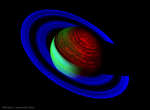 Neon Saturn
13.03.2016
If seen in the right light, Saturn glows like a neon sign. Although Saturn has comparatively little of the element neon, a composite image false-colored in three bands of infrared light highlights features of the giant ringed planet like a glowing sign.
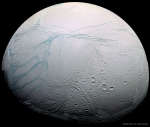 Fresh Tiger Stripes on Saturns Enceladus
27.04.2020
How will humanity first learn of extraterrestrial life? One possibility is to find it under the icy surface of Saturn's moon Enceladus. A reason to think that life may exist there are long features -- dubbed tiger stripes -- that are known to be spewing ice from the moon's icy interior into space.
 GRB 221009A
15.10.2022
Gamma-ray burst GRB 221009A likely signals the birth of a new black hole, formed at the core of a collapsing star long ago in the distant universe. The extremely powerful blast is depicted in this animated gif constructed using data from the Fermi Gamma Ray Space Telescope.
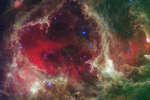 W5: Pillars of Star Formation
20.11.2011
How do stars form? A study of star forming region W5 by the sun-orbiting Spitzer Space Telescope provides clear clues by recording that massive stars near the center of empty cavities are older than stars near the edges.
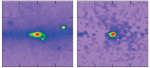 Gamma Rays from Galactic Center Dark Matter
10.03.2014
What is creating the gamma rays at the center of our Galaxy? Excitement is building that one answer is elusive dark matter. Over the past few years the orbiting Fermi Gamma-ray Space Telescope has been imaging our Galaxy's center in gamma-rays.
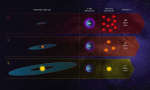 Goldilocks Zones and Stars
31.01.2020
The Goldilocks zone is the habitable zone around a star where it's not too hot and not too cold for liquid water to exist on the surface of orbiting planets. This intriguing infographic...
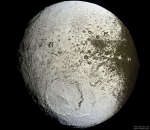 Saturns Iapetus: Painted Moon in 3D
13.07.2021
What has happened to Saturn's moon Iapetus? Vast sections of this strange world are dark brown, while others are as bright white. The composition of the dark material is unknown, but infrared spectra indicate that it possibly contains some dark form of carbon.
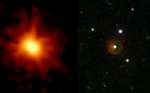 Across the Universe
28.03.2008
How far can you see? Even the faintest stars visible to the eye are merely hundreds or thousands of light-years distant, all well within our own Milky Way Galaxy. Of course, if you know where to look you can also spot the Andromeda Galaxy as a pale, fuzzy cloud, around 2.5 million light-years away.
 A Double Ringed Basin on Mercury
7.10.2009
What created the internal second ring of this double ringed basin on Mercury? No one is sure. The unusual feature spans 160 kilometers and was imaged during the robotic MESSENGER spacecraft's swing past our Solar System's innermost planet last week.
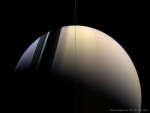 Saturn in Blue and Gold
29.08.2017
Why is Saturn partly blue? The featured picture of Saturn approximates what a human would see if hovering close to the giant ringed world. The image was taken in 2006 March by the robot Cassini spacecraft now orbiting Saturn. Here Saturn's majestic rings appear directly only as a thin vertical line.
|
January February March April May June July August September |
|||||||||||||||||||||||||||||||||||||||||||||||||