
|
You entered: orbit
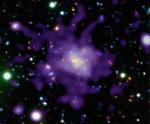 Galaxy Cluster in the Early Universe
25.02.2004
Long before medieval alchemists dreamed of transmuting base metals to gold, stellar furnaces in this massive cluster of galaxies - cataloged as RDCS 1252.9-2927 - had transformed light elements into heavy ones. In the false-color composite image individual cluster galaxies can be seen at optical and near-infrared wavelengths, shown in red, yellow, and green colors.
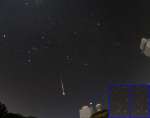 Leonid Fireball over Tenerife
22.11.2011
Historically active, this year's Leonid meteor shower was diminished by bright moonlight. Still, faithful night sky watchers did see the shower peak on November 18 and even the glare of moonlight didn't come close to masking this brilliant fireball meteor.
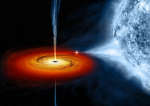 Heavy Black Hole Jets in 4U1630 47
20.11.2013
What are black hole jets made of? Many black holes in stellar systems are surely surrounded by disks of gas and plasma gravitationally pulled from a close binary star companion. Some of this material...
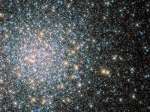 Hubble s Messier 5
25.04.2014
"Beautiful Nebula discovered between the Balance [Libra] & the Serpent [Serpens] ..." begins the description of the 5th entry in 18th century astronomer Charles Messier's famous catalog of nebulae and star clusters. Though it appeared...
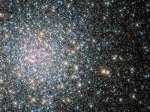 Hubble s Messier 5
19.06.2015
"Beautiful Nebula discovered between the Balance [Libra] & the Serpent [Serpens] ..." begins the description of the 5th entry in 18th century astronomer Charles Messier's famous catalog of nebulae and star clusters. Though it appeared...
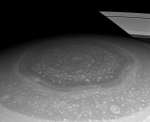 Saturns Hexagon and Rings
20.02.2013
Why would clouds form a hexagon on Saturn? Nobody is sure. Originally discovered during the Voyager flybys of Saturn in the 1980s, nobody has ever seen anything like it anywhere else in the Solar System.
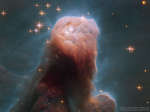 The Cone Nebula from Hubble
14.03.2017
Stars are forming in the gigantic dust pillar called the Cone Nebula. Cones, pillars, and majestic flowing shapes abound in stellar nurseries where natal clouds of gas and dust are buffeted by energetic winds from newborn stars. The Cone Nebula, a well-known example, lies within the bright galactic star-forming region NGC 2264.
 Fomalhaut's Dusty Debris Disk
10.05.2023
Fomalhaut is a bright star, a 25 light-year voyage from planet Earth in the direction of the constellation Piscis Austrinus. Astronomers first noticed Fomalhaut's excess infrared emission in the 1980s. Space and ground-based...
 APOD: 2025 January 29 Б Dust Shells around WR 140 from Webb
28.01.2025
What are those strange rings? Rich in dust, the rings are likely 3D shells -- but how they were created remains a topic of research. Where they were created is well known: in a binary...
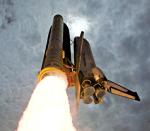 Recycling Columbia
14.11.2001
Twenty years ago this week, the Space Shuttle Columbia became the first reusable spaceship. Its second trip to low Earth orbit and back again began on November 12, 1981, following its maiden voyage by only seven months.
|
January February March April May June July August September |
|||||||||||||||||||||||||||||||||||||||||||||||||