
|
You entered: orbit
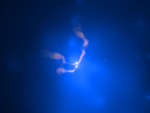 Two Black Holes Dancing in 3C 75
8.11.2008
What's happening at the center of active galaxy 3C 75? The two bright sources at the center of this composite x-ray (blue)/ radio (pink) image are co-orbiting supermassive black holes powering the giant radio source 3C 75.
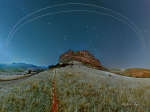 Spacecrafts Streak Over Colorado
13.03.2011
Have you ever seen a "star" drifting slowly overhead, but not known what it was? Sometimes even pointing it out to friends or family will only lead to a shrug. What you are seeing...
 Wonder and Mystery above the Very Large Telescopes
9.05.2011
What's that bright orange dot above the large telescope on the right? Even seasoned sky enthusiasts might ponder the origin of the orange orb seen by scrolling across this panoramic image, taken last December. Perhaps identifying known objects will help.
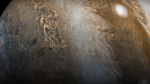 Perijove 11: Passing Jupiter
27.08.2022
Here comes Jupiter! NASA's robotic spacecraft Juno is continuing on its highly-elongated orbits around our Solar System's largest planet. The featured video is from perijove 11 in early 2018, the eleventh time Juno has passed near Jupiter since it arrived in mid-2016.
 APOD: 2023 September 6 Б HESS Telescopes Explore the High Energy Sky
5.09.2023
They may look like modern mechanical dinosaurs, but they are enormous swiveling eyes that watch the sky. The High Energy Stereoscopic System (H.E.S.S.) Observatory is composed of four 12-meter reflecting-mirror telescopes surrounding a larger telescope housing a 28-meter mirror.
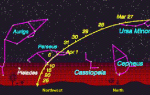 Comet Hyakutake Finder Chart for Early April
30.03.1996
During April Comet Hyakutake heads in toward the Sun after passing the Earth. At this time the comet's orbit places it north of the Earth. Remaining visible in the northern sky as it nears the Sun, it will set progressively earlier in the evening.
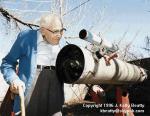 Clyde W. Tombaugh: 1906-1997
3.02.1997
Astronomer Clyde Tombaugh, discoverer of Pluto, died on January 17th. Inspiring many during his long and exceptional career, he had been living in Las Cruces, New Mexico with his wife of 60 years, Patsy. Today would have been his 91st birthday.
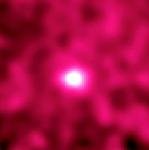 Gamma Ray Moon
17.04.1999
What if you could see gamma rays (photons with more than 40 million times the energy of visible light)? If you could, the Moon would appear brighter than the Sun! This startling notion...
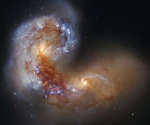 Spiral Galaxy NGC 4038 in Collision
12.08.2012
This galaxy is having a bad millennium. In fact, the past 100 million years haven't been so good, and probably the next billion or so will be quite tumultuous. Visible on the upper...
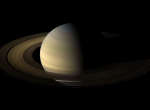 Saturn at Equinox
21.09.2014
How would Saturn look if its ring plane pointed right at the Sun? Before August 2009, nobody knew. Every 15 years, as seen from Earth, Saturn's rings point toward the Earth and appear to disappear.
|
January February March April May June July August September |
|||||||||||||||||||||||||||||||||||||||||||||||||