
|
You entered: orbit
 APOD: 2023 July 25 Б The Eagle Nebula with Xray Hot Stars
25.07.2023
What do the famous Eagle Nebula star pillars look like in X-ray light? To find out, NASA's orbiting Chandra X-ray Observatory peered in and through these interstellar mountains of star formation.
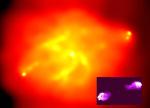 X Ray Cygnus A
10.11.2000
Amazingly detailed, this false-color x-ray image is centered on the galaxy Cygnus A. Recorded by the orbiting Chandra Observatory, Cygnus A is seen here as a spectacular high energy x-ray source. But it is actually more famous at the low energy end of the electromagnetic spectrum as one of the brightest celestial radio sources.
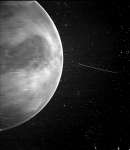 A Venus Flyby
25.02.2021
On a mission to explore the inner heliosphere and solar corona, on July 11, 2020 the Wide-field Imager on board NASA's Parker Solar Probe captured this stunning view of the nightside of Venus at distance of about 12,400 kilometers (7,693 miles).
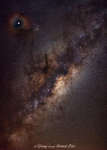 A Total Lunar Eclipse Corona
9.06.2021
This moon appears multiply strange. This moon was a full moon, specificallyбcalled a Flower Moon at this time of the year. But that didn't make it strange -- full moons occur once a month (moon-th).
 EUVE Sky Map
31.01.2002
The stars beyond the Sun and the distant galaxies should be undetectable at extreme ultraviolet wavelengths. At least that was the conventional wisdom when it was first realized that the space between the stars is filled with hydrogen, a strong absorber of extreme ultraviolet light.
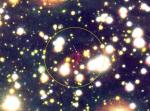 375: Candidate Quark Star
14.04.2002
Why is RJX J185635-375 so cool and so dim? Previously, this compact star held claim to being the closest neutron star -- only 150 light-years away. Now new observations and analysis indicate not only a cool temperature for RXJ J185635-375, pictured above, but also a larger distance: roughly 450 light-years away.
 The Strange Tailing Side of Saturns Iapetus
10.10.2007
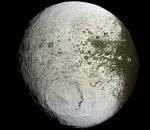
What has happened to Saturn's moon Iapetus? Vast sections of this strange world are dark as coal, while others are as bright as ice. The composition of the dark material is unknown, but infrared spectra indicate that it possibly contains some dark form of carbon.
 P2010 A2: Unusual Asteroid Tail Implies Powerful Collision
3.02.2010
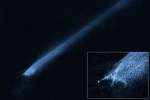
What is this strange object? First discovered on ground based LINEAR images on January 6, the object appeared unusual enough to investigate further with the Hubble Space Telescope last week. Pictured above, what Hubble saw indicates that P/2010 A2 is unlike any object ever seen before.
 Binary Black Hole in 3C 75
14.03.2010
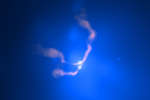
What's happening in the middle of this massive galaxy? There, two bright sources at the center of this composite x-ray (blue)/radio (pink) image are thought to be co-orbiting supermassive black holes powering the giant radio source 3C 75.
 Zodiacal Light Panorama
5.04.2012
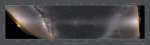
Sweeping from the eastern to western horizon, this 360 degree panorama follows the band of zodiacal light along the solar system's ecliptic plane. Dust scattering sunlight produces the faint zodiacal glow that spans...
|
January February March April May June July August September |
|||||||||||||||||||||||||||||||||||||||||||||||||