
|
You entered: orbit
 The Matter of Galaxy Clusters
24.10.2001
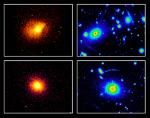
Situated over 2,000,000,000 (two billion) light-years from Earth, galaxies in cluster Abell 2390 (top) and MS2137.3-2353 (bottom) are seen in the right hand panels above, false-color images from the Hubble Space Telescope. Corresponding panels on the left reveal each cluster's x-ray appearance in images from the Chandra X-ray Observatory.
 The Cosmic X-Ray Background
9.11.2000
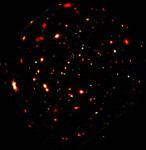
Early on, x-ray satellites revealed a surprising cosmic background glow of x-rays and astronomers have struggled to understand its origin. Now, peering through a hole in the obscuring gas and dust...
 In the Glare of Alpha Centauri
28.06.2012
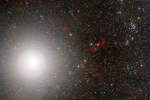
The glare of Alpha Centauri, one of the brightest stars in planet Earth's night sky, floods the left side of this southern skyscape. A mere 4.3 light-years distant, Alpha Centauri actually consists of two component stars similar in size to the Sun, locked in a mutual orbit.
 Proxima Centauri: The Closest Star
18.01.2016
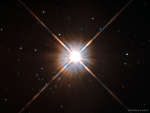
Does the closest star to our Sun have planets? No one is sure -- but you can now follow frequent updates of a new search that is taking place during the first few months of this year. The closest star, Proxima Centauri, is the nearest member of the Alpha Centauri star system.
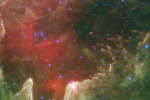 W5: Pillars of Star Creation
16.09.2008
How do stars form? A study of star forming region W5 by the orbiting Spitzer Space Telescope provides clear clues by recording that massive stars near the center of empty cavities are older than stars near the edges.
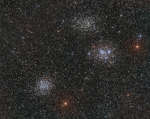 Three Clusters in Puppis
18.02.2022
Galactic or open star clusters are young. The swarms of stars are born together near the plane of the Milky Way, but their numbers steadily dwindle as cluster members are ejected by galactic tides and gravitational interactions.
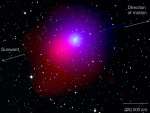 The Swift View of Comet Lulin
21.02.2009
Now growing brighter, Comet Lulin is headed for its closest approach to planet Earth early next week. But the comet's greenish glow, familiar to earthbound skygazers, is replaced by false colors in this premier view from the orbiting Swift satellite.
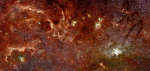 The Galactic Core in Infrared
7.01.2009
What's happening at the center of our Milky Way Galaxy? To help find out, the orbiting Hubble and Spitzer space telescopes have combined their efforts to survey the region in unprecedented detail in infrared light.
 The Black Hole in the Milky Way
2.11.2012
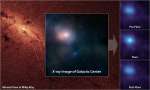
At the center of our Milky Way Galaxy, a mere 27,000 light-years away, lies a black hole with 4 million times the mass of the Sun. Fondly known as Sagittarius A* (pronounced A-star)...
 JKCS041: The Farthest Galaxy Cluster Yet Measured
28.10.2009
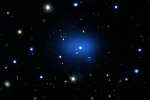
What if we could see back to the beginning of the universe? We can -- since it takes the age of the universe for light to cross the universe. Peering at distant objects, therefore, tells us about how the universe used to be, even near its beginning.
|
January February March April May June July August September |
|||||||||||||||||||||||||||||||||||||||||||||||||