
|
You entered: sky
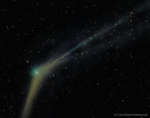 Comet Catalina Emerges
7.12.2015
Comet Catalina is ready for its close-up. The giant snowball from the outer Solar System, known formally as C/2013 US10 (Catalina), rounded the Sun last month and is now headed for its closest approach to Earth in January.
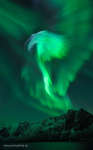 Eagle Aurora over Norway
23.10.2016
What's that in the sky? An aurora. A large coronal mass ejection occurred on our Sun five days before this 2012 image was taken, throwing a cloud of fast moving electrons, protons, and ions toward the Earth.
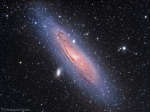 M31: The Andromeda Galaxy
27.12.2016
What is the nearest major galaxy to our own Milky Way Galaxy? Andromeda. In fact, our Galaxy is thought to look much like Andromeda. Together these two galaxies dominate the Local Group of galaxies. The diffuse light from Andromeda is caused by the hundreds of billions of stars that compose it.
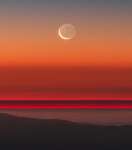 Old Moon in the New Moon s Arms
20.01.2018
Also known as the Moon's "ashen glow" or the "Old Moon in the New Moon's arms", earthshine is earthlight reflected from the Moon's night side. This stunning image of earthshine from a young crescent moon was taken from Las Campanas Observatory, Atacama Desert, Chile, planet Earth near moonset on January 18.
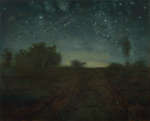 Starry Night by Jean Franцois Millet
13.03.2020
A dramatic nocturnal landscape from around 1850, this oil painting is the work of French artist Jean-Francois Millet. In the dark and atmospheric night sky are shooting stars, known too as meteors, above a landscape showing a path through the faintly lit countryside that leads toward trees and a cart in silhouette on the horizon.
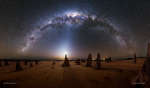 Milky Way over the Pinnacles in Australia
11.10.2020
What strange world is this? Earth. In the foreground of the featured image are the Pinnacles, unusual rock spires in Nambung National Park in Western Australia. Made of ancient sea shells (limestone), how these human-sized picturesque spires formed remains unknown.
 Cosmic Latte: The Average Color of the Universe
27.12.2020
What color is the universe? More precisely, if the entire sky were smeared out, what color would the final mix be? This whimsical question came up when trying to determine what stars are commonplace in nearby galaxies. The answer, depicted above, is a conditionally perceived shade of beige. In computer parlance: #FFF8E7.
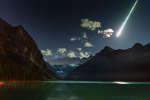 Fireball over Lake Louise
12.10.2021
What makes a meteor a fireball? First of all, everyone agrees that a fireball is an exceptionally bright meteor. Past that, the International Astronomical Union defines a fireball as a meteor brighter than apparent magnitude -4, which corresponds (roughly) to being brighter than any planet -- as well as bright enough to cast a human-noticeable shadow.
 The Large Cloud of Magellan
7.09.2023
The 16th century Portuguese navigator Ferdinand Magellan and his crew had plenty of time to study the southern sky during the first circumnavigation of planet Earth. As a result, two fuzzy cloud-like objects easily...
 Periodic Comet Swift Tuttle
8.08.2024
A Halley-type comet with an orbital period of about 133 years, Comet 109P/Swift-Tuttle is recognized as the parent of the annual Perseid Meteor Shower. The comet's last visit to the inner Solar System was in 1992.
|
January February March April May June July August September October |
|||||||||||||||||||||||||||||||||||||||||||||||||